When Branches Intertwine: Unexpected Connections Across Families
In genealogy, there is a quiet moment that often catches researchers off guard.
You begin with one family line—carefully traced, documented, and understood. Then, somewhere along the way, another name appears. A familiar surname in an unexpected place. A shared ancestor you didn’t anticipate. A connection that suddenly links two separate branches of your research into something far more complex than you imagined.
It is in these moments that family history stops being a linear pursuit and becomes something more intricate—more human.
Because families are rarely as separate as they first appear. Their branches often intertwine in ways that reshape everything you thought you knew.
The Nature of Interconnected Families
At the beginning of any genealogy journey, it is natural to think in straight lines: parent to child, generation to generation. But real family history is rarely linear.
Over time, you begin to see patterns:
Families migrating to the same regions
Repeated surnames appearing in different branches
Marriages between distant relatives or neighboring families
Communities built through repeated interconnections
These overlaps are not coincidences. They reflect how tightly woven communities once were—especially in rural areas, small towns, and early immigrant settlements.
Families didn’t just live near each other. They often became each other.
Discovering the Unexpected Link
Unexpected connections often emerge during routine research.
You might find:
A marriage record that links two families you’ve researched separately
A DNA match that appears in more than one branch
A census record listing individuals you recognize from another line
A shared witness on multiple vital records
At first, these details seem minor. But as they accumulate, a pattern begins to form.
And suddenly, two branches of your family tree are no longer separate—they are connected.
The Role of DNA in Revealing Intertwined Branches
Modern genetic genealogy has made these discoveries more common than ever before.
Through DNA testing services such as AncestryDNA and MyHeritage, researchers are increasingly uncovering shared ancestors across different family lines.
DNA can reveal:
Previously unknown cousin relationships
Hidden half-sibling connections
Shared ancestral couples across multiple branches
Surprising overlaps between documented family lines
What was once invisible in paper records can now be confirmed through genetic evidence.
But DNA is only the beginning. The real work comes in tracing how those connections came to be.
Collateral Lines: The Hidden Structure of Family Trees
One of the most important concepts in understanding intertwined branches is the idea of collateral lines.
Collateral lines include:
Siblings of direct ancestors
Their spouses and children
Extended cousins and in-laws
Entire branches that run parallel to your direct lineage
These lines are often overlooked—but they hold the key to understanding how families connect over time.
By following collateral lines, you may discover:
Shared migration paths
Repeated intermarriage between families
Community networks that shaped your ancestors’ lives
In many cases, these connections explain why certain surnames appear repeatedly in your tree.
Communities That Shaped Family Connections
Intertwining branches are especially common in close-knit communities.
In small towns or early settlements, families often:
Worked the same trades
Attended the same churches
Migrated together
Married within familiar social circles
Over generations, these repeated interactions created dense webs of connection.
A single marriage could link two families. A generation later, another marriage might reinforce that link. Over time, entire communities become interwoven into shared family networks.
The Research Challenge of Overlapping Trees
While discovering connections is exciting, it also introduces complexity.
Intertwined branches can lead to challenges such as:
Confusing individuals with similar names
Mistakenly merging separate family lines
Overlooking duplicate ancestors
Misinterpreting DNA matches
This is where careful documentation becomes essential.
To manage complexity:
Always verify records across multiple sources
Track relationships clearly with notes and citations
Use timelines to distinguish individuals with similar identities
Revisit earlier assumptions as new evidence emerges
Genealogy is not just about discovery—it is about accuracy.
When One Ancestor Appears Twice
One of the most surprising discoveries in genealogy is finding the same ancestor in multiple branches of your tree.
This can happen when:
Cousins from related families marry
Small communities interconnect over generations
Migration patterns bring related families back together
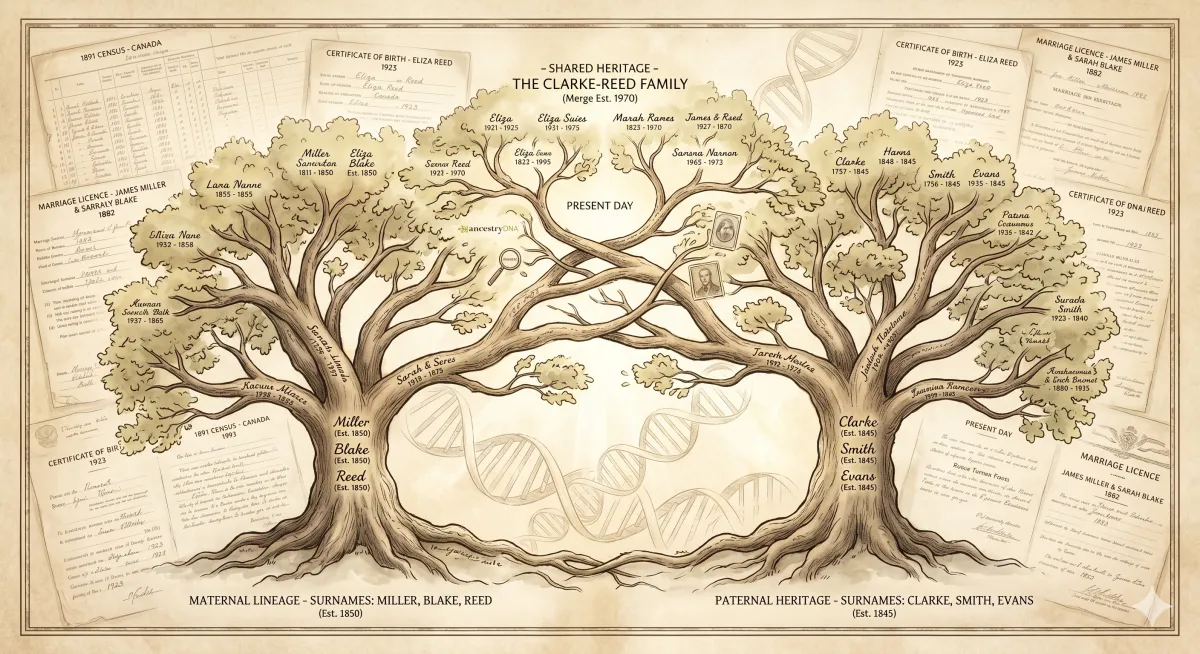
In these cases, your family tree begins to loop back on itself—creating a network rather than a straight line.
Far from being a complication, this often reveals a deeper truth: your ancestry is more interconnected than you realized.
Mapping Intertwined Branches
Visualizing these connections can be incredibly helpful.
Consider using:
Color-coded family trees
Relationship mapping software
Timeline charts showing overlapping events
Geographic maps of ancestral movement
Many genealogy platforms, including FamilySearch, offer tools that help visualize relationships across branches.
Seeing the connections laid out visually often reveals patterns that are not obvious in text alone.
The Emotional Impact of Connection
Discovering intertwined branches is not just a technical achievement—it is an emotional one.
It can bring:
A sense of wonder at how lives intersected
A deeper appreciation for shared history
Surprise at unexpected relationships
A feeling of belonging within a larger story
It also reminds us that family history is not isolated. It is shared—often in ways we do not expect.
What These Connections Teach Us
Intertwined branches offer more than genealogical data. They offer perspective.
They show us that:
Families are shaped by community, not isolation
History is interconnected across generations
Identity is built through relationships as much as lineage
The past is more complex than any single branch can show
Every connection adds depth to the story.
Embracing the Complexity of Your Tree
It is tempting to want a clean, simple family tree. But real ancestry is rarely simple.
Instead of viewing intertwined branches as confusion, consider them enrichment.
They reveal:
The closeness of ancestral communities
The repetition of shared experiences
The resilience of family networks over time
Your tree is not just growing outward—it is weaving together.
Closing Reflection: A Living Network of Stories
When branches intertwine, something remarkable happens. Separate lines of inquiry become part of a shared narrative. Individual stories begin to overlap, reinforcing one another in unexpected ways.
What once looked like a simple tree becomes a living network—complex, interconnected, and deeply human.
And at the center of it all is a powerful realization: your family history is not just a collection of individuals. It is a web of relationships, shaped by chance, geography, community, and time.
Every connection you uncover adds another thread to that web.
And with each thread, the picture becomes clearer—not simpler, but richer.
Because in genealogy, as in life, we are never as separate as we first appear.