The Stories That Surface: What Census and Vital Records Reveal
Every family history researcher eventually learns a quiet truth: the most powerful stories are often hiding in plain sight.
They are not always found in dramatic letters or treasured heirlooms. More often, they are tucked inside government forms, registry books, and handwritten entries made by officials who could never have known how important those records would become.
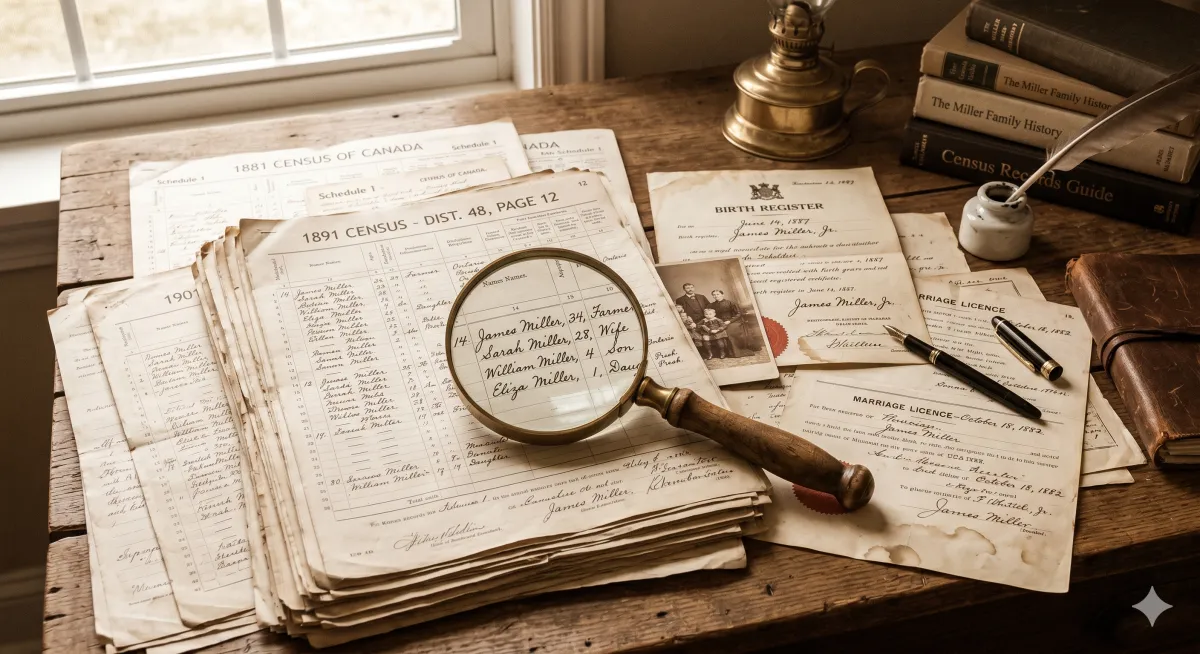
Census records and vital records may seem simple at first glance—just names, dates, and places. But when read carefully, they become something much richer: a living snapshot of your ancestors’ everyday lives.
These records don’t just tell you who your ancestors were. They begin to show you how they lived.
Why Census and Vital Records Matter
In genealogy, census and vital records form the backbone of reliable research. While DNA can suggest connections and family stories can provide clues, these documents provide documented proof.
Together, they help you:
Confirm family relationships
Track movement over time
Understand household structure
Identify gaps or inconsistencies in your tree
Without them, family history becomes speculation. With them, it becomes evidence-based storytelling.
Reading Between the Lines of Census Records
Census records are among the most valuable tools in genealogy. Conducted at regular intervals, they capture families at specific moments in time.
In Canada, for example, national censuses were taken at various intervals and can be accessed through archives such as Library and Archives Canada. In the United States, census records are widely available through the National Archives and platforms like Ancestry.
At first glance, a census record might seem straightforward:
Name
Age
Birthplace
Occupation
Household members
But the real insight comes when you compare records over time.
What Census Records Can Reveal
When you line up multiple census entries across decades, patterns begin to emerge:
1. Family Growth and Change
You can track children being born, growing up, and eventually leaving home.
2. Migration Patterns
Families often moved for work, land, or opportunity. Census data helps you trace these movements geographically.
3. Economic Shifts
Changes in occupation or housing can reveal financial stability—or hardship.
4. Household Composition
You may discover extended family members, boarders, or even previously unknown relatives living under one roof.
The Hidden Challenges of Census Records
Census data is powerful, but not perfect.
Common challenges include:
Misspelled names
Incorrect ages
Transcription errors
Missing individuals
Language barriers
These inconsistencies are not mistakes in your research—they are part of the historical reality. Interpreting them carefully is part of the genealogist’s craft.
Vital Records: The Milestones of Life
While census records capture households over time, vital records document key life events.
These include:
Birth certificates
Marriage records
Death certificates
Together, they form the essential milestones of a person’s life journey.
Birth Records: Beginnings and Identity
Birth records often provide:
Full name
Date and place of birth
Parents’ names (sometimes including maiden names)
Occupation of parents
These details are critical for linking generations and confirming family lines.
Even small variations in spelling or location can lead to new discoveries when cross-referenced with other records.
Marriage Records: Connecting Family Branches
Marriage records are especially valuable because they connect two separate family lines.
They often reveal:
Spouses’ full names
Ages at marriage
Residences
Occupations
Witnesses (who may be relatives)
Witness names are particularly important—they often point to siblings, cousins, or close family friends.
This is where branches of your family tree begin to intertwine.
Death Records: The Final Chapter
Death certificates can provide surprising depth, including:
Cause of death
Place of burial
Informant (often a family member)
Birth details that may not appear elsewhere
While they mark an ending, they often open new research pathways—especially when earlier records are incomplete.
Putting the Puzzle Together
Individually, census and vital records are informative. But their true power emerges when used together.
For example:
A census record shows a child living in a household in 1911
A birth record confirms their arrival in 1908
A marriage record later reveals their spouse and new family branch
A death record completes the timeline
Piece by piece, a life story begins to take shape.
Finding Patterns in the Data
One of the most rewarding aspects of genealogy is recognizing patterns that aren’t immediately obvious.
Look for:
Repeated names across generations
Common occupations within families
Migration routes between regions or countries
Clusters of family members in specific areas
These patterns often reveal deeper cultural, economic, or historical influences shaping your ancestors’ lives.
Expanding Your Research Beyond the Basics
Once you’ve mastered census and vital records, you can expand into related sources:
Church registers
Land ownership records
Military enlistment documents
Immigration and passenger lists
Newspaper archives
Each additional record type adds another layer of detail to your growing family story.
Interpreting Gaps and Silence
Not every story is fully recorded. Sometimes, the absence of information is just as meaningful as its presence.
Missing children in census records may indicate:
Early death
Boarding with relatives
Institutional care
Recording errors
Gaps are not failures—they are clues. They invite deeper investigation.
Turning Records into Stories
It’s easy to get lost in names and dates. But the real goal of genealogy is storytelling.
Instead of viewing records as data points, try to ask:
What challenges did this family face?
Why did they move from one place to another?
What does their occupation tell me about daily life?
How did historical events shape their decisions?
This is where genealogy becomes more than research—it becomes connection.
A Living Record of the Past
Census and vital records are more than administrative documents. They are fragments of real lives—captured briefly, preserved unexpectedly, and waiting to be rediscovered.
Each record is a moment frozen in time:
A child standing beside their parents
A marriage recorded in ink on a worn page
A life summarized in a few carefully written lines
Together, they form the foundation of your family history.
Closing Reflection
As you explore these records, remember that you are not just gathering facts—you are reconstructing lives.
Each entry adds depth to your understanding of who your ancestors were, how they lived, and what shaped their world.
And as those details come together, something remarkable happens: your family tree stops being a diagram and begins to feel like a story—one filled with resilience, movement, love, loss, and connection.
The stories have always been there. Census and vital records simply help them surface.