Discovering Ancestors Who Served Their Country
Discovering Ancestors Who Served Their Country
Every year, communities gather at cenotaphs and national cemeteries to observe days of remembrance. We look at stone monuments etched with long lists of names, or rows of symmetrical military headstones catching the summer sun. For the casual observer, these are solemn symbols of collective national history. But for the genealogist, those names belong to our family tree. They represent the young men and women who stepped away from their family farms, left their urban factories, and said goodbye to their loved ones to serve a cause greater than themselves.
Discovering a military ancestor—a "family patriot"—is one of the most profoundly moving experiences in family history research.
When an ancestor put on a military uniform, they entered a massive, bureaucratic machine. Ironically, this bureaucracy is a gift to modern researchers. The military kept meticulous records. From physical descriptions and medical histories to details of battlefield movements and heartbreaking letters written home, military files allow us to reconstruct our ancestors' lives with cinematic detail. By learning how to access and interpret these resources, we can honor their sacrifices and bridge the gap between textbook history and personal heritage.
Why Military Records Are Genealogical Treasures
If you have ever hit a genealogical "brick wall," military records may be the dynamite you need to break through it. Because governments needed to account for every soldier, verify identities for pensions, and track casualties, military files often contain a concentration of personal data unmatched by standard civilian records.
A single complete service file or pension application can reveal:
Physical Characteristics: Your ancestor’s height, weight, eye color, hair color, and even identifying marks like scars or tattoos.
Vital Timelines: Exact dates and locations of births, marriages, and children, often verified by accompanying certificates or affidavits from neighbors.
Geographic Journeys: The precise trajectory of their life, tracking them from their hometown enlistment station to overseas battlefields, hospitals, and post-war residences.
Beyond the raw data, these records provide unmatched historical context. They tell you exactly where your ancestor was during major global turning points, transforming global events like World War I, World War II, or the American Civil War from chapters in a textbook into direct episodes of your family story.
Stories Hidden in Service Records
When we think of military research, we often imagine grand tales of battlefield heroism. While those stories certainly exist, the most poignant narratives hidden in service files are often deeply human, intimate, and raw.
Consider the medical records included in many personnel files. They might reveal that an ancestor survived a bout of the 1918 Spanish Flu while stationed in England, or that they carried shrapnel in their shoulder for the rest of their civilian life. Discipline logs, pay ledgers, and promotion records reveal aspects of their personality—showing us whether they were a rule-follower who quickly rose through the ranks or a young, homesick private who lost a week's pay for being late to formation.
Furthermore, pension files—particularly those from the 19th and early 20th centuries— frequently contain personal letters written by the soldier to their parents or spouse, or testimonies from comrades detailing the soldier's character and final moments. These documents preserve their true voice, allowing them to speak to us across the generations.
Deep Dive: Canadian and American Military Resources
Depending on where your family patriots served, there are distinct, highly organized repositories available to researchers. Because North American families frequently crossed borders, it is worth checking records in both countries.
1. Canadian Military Records
Library and Archives Canada (LAC): This is the holy grail for Canadian research. LAC has fully digitized personnel files for the First World War, allowing you to view every page of an ancestor's attestation, medical history, and dental records. Databases for the War of 1812, the Red River Rebellion, and the South African (Boer) War are also extensive.
Second World War Records: For privacy reasons, complete WWII service files for soldiers who survived the war must still be requested through an access information process, but files for those who died in service are widely accessible online.
2. American Military Records
The National Archives and Records Administration (NARA): Based in Washington, D.C., and St. Louis, Missouri, NARA holds federal military records ranging from the Revolutionary War to the mid-20th century. (Note: A devastating fire in 1973 destroyed 80% of Army personnel records from 1912 to 1960, but alternative records like draft cards and payrolls help fill the gaps).
Fold3 by Ancestry: A premier digital repository dedicated entirely to military history. It features incredible collections of Civil War pension files, WWII draft registration cards (the famous "Old Man's Draft"), and unit cruise books.
Step-by-Step: Creating a Military Heritage Scrapbook
Once you have gathered your ancestor's military files, don't leave them sitting in a digital folder on your hard drive. Bring their story into the physical world by creating a dedicated military heritage scrapbook or digital memory book.
Map Their Journey: Use Google Earth or historical maps alongside their unit's regimental history. Plot a timeline showing where they enlisted, where they trained, where they fought, and where they returned home.
Incorporate Contextual Media: If you don't have personal photos of your ancestor in uniform, find public-domain photographs of their regiment, the ship they sailed on, or the specific equipment and vehicles they used.
Transcribe the Hard-to-Read Text: Military files are notoriously filled with confusing acronyms, medical jargon, and cramped handwriting. Create a page in your scrapbook dedicated to a clean, typed transcript of their enlistment paper and key letters, alongside a glossary explaining what terms like "G.S.W." (Gunshot Wound) or "O.A.S." (On Active Service) meant.
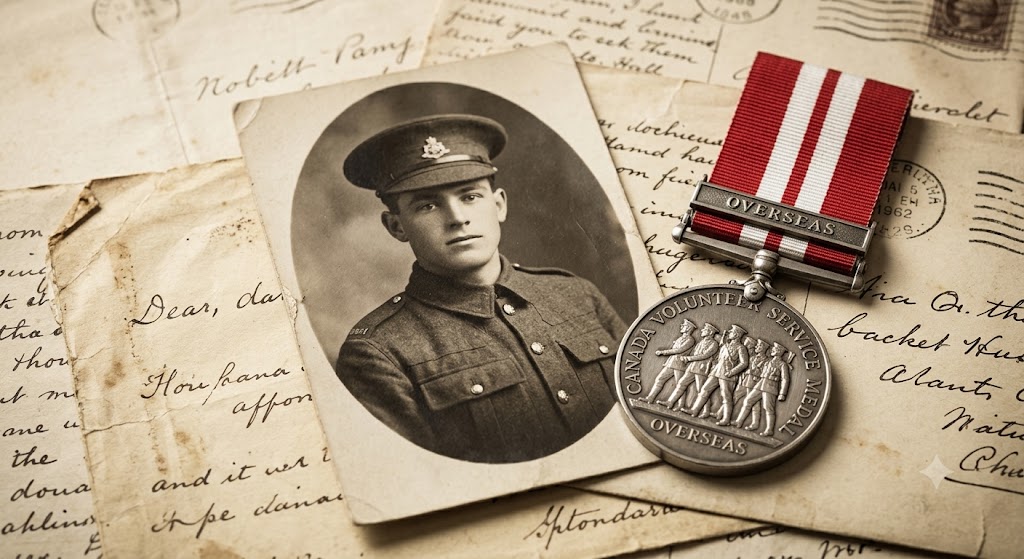
Display the Legacy: Conclude the scrapbook with photos of their medals, their headstone or memorial wall entry, and modern photos of your family honoring them.
Personal Reflection: The Trunks in the Attic
Growing up, military history always felt incredibly abstract to me—until the day my family uncovered an old, olive-drab metal footlocker in an older relative's attic. Inside, wrapped in yellowed tissue paper, was a wool uniform, a pair of tarnished brass cap badges, and a bundle of letters tied with a faded ribbon.
Holding those letters, I could see where the ink had smudged when the writer was interrupted by his unit moving out. I realized that the young man who wore that uniform wasn't a mythical character from a history documentary; he was an ordinary kid who missed his mother's cooking, worried about the crops back home, and felt terrified of what lay ahead.
Unlocking that file didn't make me glorify war; it made me deeply respect the quiet, everyday resilience of the people who built our family's future. It changed the way I look at old family photos forever.
Conclusion & Call to Action
The freedom and peace we enjoy today were bought and paid for by the ordinary individuals in our family trees who did extraordinary things when history called upon them. Discovering their military records ensures that their sacrifices are documented, remembered, and carried forward.
Now, it’s your turn: Do you have a family patriot in your family tree? What branch of service did they serve in, and have you successfully found their service file? Leave a comment below and share their name so we can honor their memory together!