When an Occupation Becomes a Road Map
When an Occupation Becomes a Road Map
When we find an occupation listed for an ancestor, it is tempting to simply record it and move on.
Farmer. Labourer. Clerk. Miner. Teacher. Carpenter.
The occupation becomes another entry in our genealogy database, sitting alongside a birth date, marriage date and place of residence. But sometimes an occupation is much more than a description of how someone earned a living. It can become a road map—a clue that helps us understand where an ancestor went, why they moved and the life they built along the way.
I discovered this while researching my grandfather.
His occupation was listed as a ship's plater, a specialized trade associated with the construction of ships. At first, it was simply one more fact I knew about him. The more I researched, however, the more I realized that his occupation was one of the threads that connected the many places he lived and worked.
His story began in the shipyards of Glasgow, Scotland.
Following the Work
Shipbuilding was an important industry in Glasgow, and for a young man with the skills of a ship's plater, the shipyards provided an opportunity to build a career.
But his working life did not remain in Glasgow.
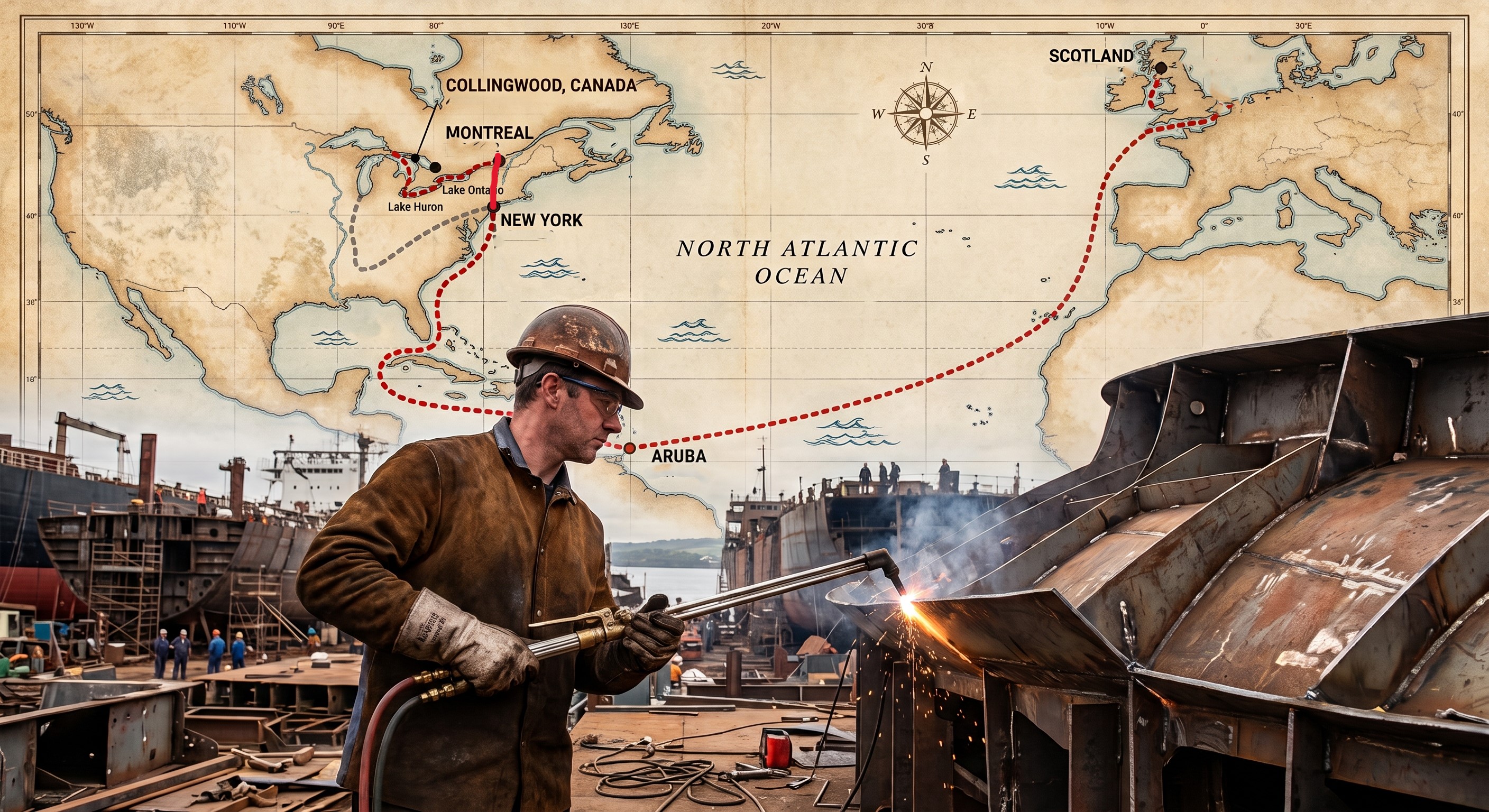
His occupation eventually took him into the Royal Naval Volunteer Reserve, and later to Standard Oil in Aruba. From there, his journey continued to North America, including a stop at Ellis Island and New Jersey, before eventually bringing him to Canada.
In Canada, his skills took him into the shipyards of Montreal, Quebec, Midland, Ontario, and Collingwood, Ontario.
When I looked at the locations individually, they were simply places where my grandfather had lived or worked.
When I looked at them through the lens of his occupation, the story changed.
There was a pattern.
His movements were not random. His skills as a ship's plater created opportunities, and those opportunities influenced where he went next.
His occupation had become a road map.
What Exactly Was a Ship's Plater?
One of the challenges of genealogy is that occupational titles can lose their meaning over time.
Today, we might recognize the general idea of a shipbuilder, but the specialized trades involved in ship construction are less familiar.
A ship's plater worked with the large metal plates that formed the hull and other structural parts of a vessel. It was skilled, demanding work that required an understanding of measurements, materials and ship construction.
Understanding what the occupation actually involved gave me another way to understand my grandfather.
It also gave me something else that is extremely valuable in genealogy: places to look for evidence.
If I knew he worked in shipbuilding, I could investigate the shipyards.
If he worked for a particular company, I could investigate that employer.
If he belonged to a naval organization, I could look for military records.
If he moved to another city, I could ask whether shipbuilding or another related industry had brought him there.
The occupation generated questions, and those questions generated records.
Let the Occupation Lead You
This is where an occupation can become particularly useful in genealogical research.
Instead of asking only: Where did my ancestor live?
Ask:
Why might they have lived there?
Sometimes the answer is connected to their work. Here are some examples:
A railway employee may have moved as railway lines expanded.
A miner may have followed employment from one mining community to another.
A teacher may have moved from school to school.
A domestic servant may have moved when employment changed.
A sailor may have travelled between ports.
A skilled tradesperson may have gone wherever their particular skills were needed.
Once you understand the occupation, movements that previously seemed puzzling can begin to make sense.
Follow the Occupational Trail
If you discover an unfamiliar occupation in your family tree, don't simply copy the word into your family history and move on. Stop and investigate it. Start by finding out what the occupation meant during the period in which your ancestor worked. The same occupational title could have had a different meaning in another time or place.
Then ask where that work was carried out.
Was it connected to a particular industry? A company? A mine? A railway? A factory? A shipyard? A government department?
Once you know that, you have new avenues for research.
Look for:
employment records
trade or union records
company histories
newspapers
city directories
military records
apprenticeship records
professional organizations
photographs
workplace records
immigration and border records
Each source can add another piece to the occupational story.
And don't overlook newspapers. Employment changes, promotions, accidents, retirements, awards and other workplace events were sometimes reported in local newspapers. These small notices can provide details that never appear in traditional genealogical records.
An Occupation Can Connect the Dots
One of the most useful things I have learned from researching my grandfather is that genealogy is rarely about finding one perfect record.
It is about connecting evidence. For example:
A census might tell you an occupation.
A city directory might tell you where the person worked.
A newspaper might identify an employer.
An immigration record might show when they crossed a border.
A military record might explain another period of their life.
A shipyard record might confirm that their particular skill was in demand.
Individually, each record tells only part of the story.
Together, they can reveal a life.
For my grandfather, following his occupation helped me understand a journey that stretched from Scotland to the Caribbean, the United States and Canada. It also helped me understand him as more than a name on a family tree. He was a skilled tradesman whose abilities shaped the opportunities available to him and, in turn, shaped the places where his life unfolded.
Look Again at the Occupations in Your Family Tree
Take a look at your own family tree.
Find an occupation you have recorded but never really investigated.
Maybe it is something familiar, such as a farmer or teacher. Or perhaps it is an occupation you have never heard of.
Instead of treating it as another fact, turn it into a question.
What did this person actually do?
Where would they have done this work?
Who might have employed them?
What skills did they need?
Could their occupation explain a move or change in their circumstances?
You may discover that the occupation you almost overlooked is actually one of the most useful clues in your research.
My grandfather's occupation eventually became the foundation for a much larger family story, one that I explored in my book Waves of Steel: A Shipbuilder's Legacy.
But the lesson I took from that research applies far beyond his story.
Sometimes the key to understanding where an ancestor went is hidden in what they did for a living.
So the next time you find an occupation in a record, don't just write it down. Follow it. It might take you somewhere you never expected to go.