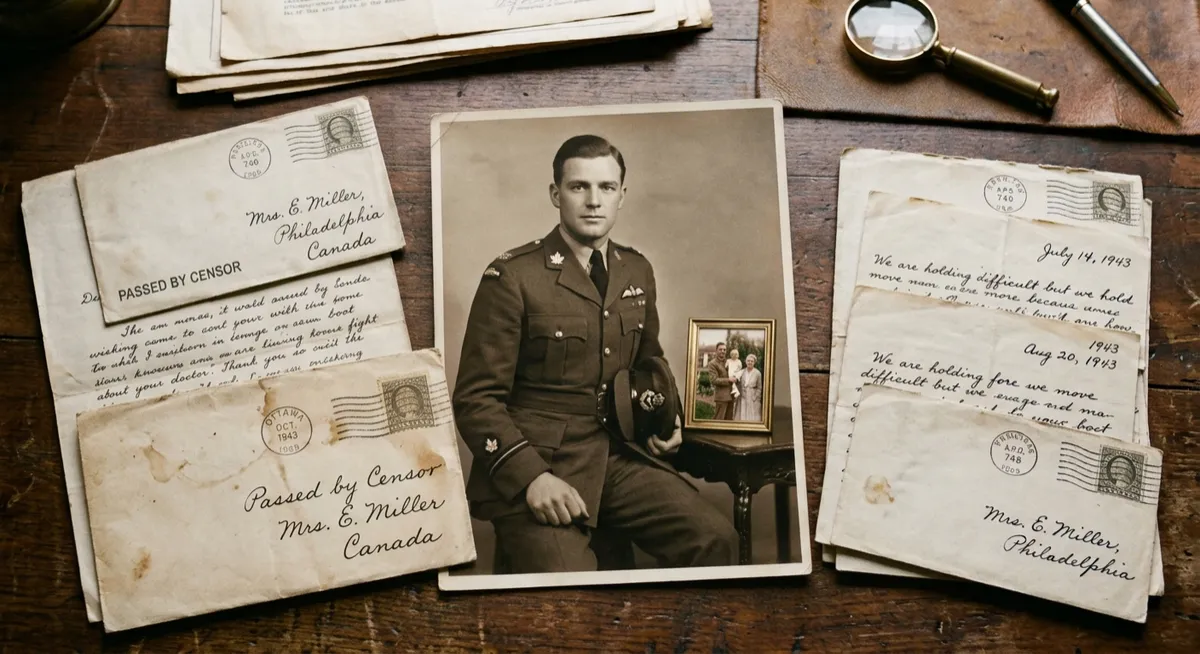
From the Battlefied to the Family Tree
From the Battlefield to the Family Tree: Bringing Our Ancestors’ Stories to Life
Military records can tell us where an ancestor served, but family history research helps us understand the person behind the uniform.
More Than a Name on a Service Record
When we discover that an ancestor served during wartime, it can feel as though we have uncovered an important piece of our family history. A military record may provide an enlistment date, a service number, a rank or details of a unit. A medal may confirm a period of service, while a photograph may preserve the face of someone whose story has been passed down through generations.
Yet these discoveries are only the beginning.
Behind every service record was a person with a family, an occupation, friendships and hopes for the future. Some left home as young adults, while others had spouses and children waiting for their return. Some served overseas, others worked closer to home, and many contributed in ways that did not involve combat.
Our task as family historians is to connect the military evidence with the wider story of an ancestor’s life. We want to understand not only where that person served, but also who they were before their service, how their experiences affected their lives and what happened when their service ended.
Begin Before the Uniform
One of the most effective ways to understand an ancestor’s military experience is to establish their life before they entered service.
Census records, birth registrations, school records, employment documents and local newspapers can help reconstruct their early years. Where did they grow up? What work did they do? Did they live in a rural community, an industrial town or a large city? Were they already married, or were they supporting parents and younger siblings?
These details provide historical context. A young man who enlisted from a mining community, for example, may have left behind a family whose livelihood depended on his wages. A woman who joined a military nursing service may have already trained in a profession that shaped her decision to serve.
The circumstances differed from one generation to another. An ancestor who served in the First World War experienced a different world from someone who participated in a later peacekeeping mission. By understanding the time and place in which they lived, we can avoid treating every military experience as though it were the same.
Start with the records that establish the person’s identity, then use that information to guide your search through military and historical collections.
Read the Military Record in Context
Military records often contain details that are unfamiliar to family historians. Abbreviations, unit names, service numbers and references to postings or transfers can make a file difficult to interpret at first.
Take time to understand what each entry actually tells you. An enlistment date establishes when a person entered service, but it does not necessarily indicate when they first experienced active operations. A posting may identify where someone was stationed without proving that they took part in a particular event.
If a record names a regiment, ship, squadron or other unit, research its history. Unit histories, war diaries, operational records and official histories can help establish what was happening during the period your ancestor served.
For Canadian military research, Library and Archives Canada provides a useful starting point:
https://www.canada.ca/en/library-archives/collection/research-help/military-history.html
For ancestors who served with another country's armed forces, investigate the relevant national archives. The records available will depend on the country, service branch and period.
Remember that the history of a unit provides context, not proof of an individual's precise experience. A unit may have participated in a major battle, but further evidence is needed to establish whether your ancestor was present at that time.
Follow the Family at Home
Military service affected more than the person who wore the uniform. It also shaped the lives of relatives who remained at home.
Letters, postcards, family photographs, newspaper notices and civil records can help reveal what happened to spouses, children, parents and siblings during a period of service. Family members may have moved, taken on additional work or cared for children while a relative was away.
Census records can help establish where family members lived before and after a conflict. Electoral registers, city directories and local newspapers may provide further details about employment, addresses and community activities.
If an ancestor did not return home, investigate the effects on the family as well as the circumstances of their death. Death registrations, casualty lists, pension records and correspondence may help explain what relatives knew and when they learned it.
These sources can also correct assumptions that have become part of family tradition. A story that someone “never came home” might refer to a death overseas, but it could also describe a separation, emigration or a decision to settle somewhere else after service. The evidence should guide the conclusion.
Look Beyond Combat
Military history is often told through battles and major campaigns, but not every ancestor who served experienced combat. Many worked in administration, transport, communications, medical care, engineering, maintenance and supply. Others served in naval reserve organisations, merchant shipping or peacekeeping operations.
These distinctions matter when reconstructing a life. A person who worked in a shipyard contributed differently from a merchant seafarer, and both had experiences distinct from those of a member of the armed forces. Their work may nevertheless have been closely connected to the same historical events.
Women’s service deserves particular attention. Nursing sisters, members of women’s military services and women in other wartime roles may appear in different records from those used to research male relatives. Civilian employment and volunteer service may require an entirely different research approach.
The absence of a conventional military service file does not mean an ancestor made no contribution. It may mean that the relevant records are held elsewhere or that the family story describes a different kind of service.
Follow the Clues in Photographs and Personal Objects
Family photographs and inherited objects can help connect documentary evidence with the person behind it.
A uniform may reveal a service branch or approximate period. A badge may suggest a particular organisation or rank. A letter may include a ship's name, a location or a reference to a unit. Even a handwritten inscription on the back of a photograph can provide a name or date that opens a new research path.
Consider, for example, a military hat badge found on a farm north of Hanna, Alberta. Its design can be compared with documented examples in museum collections, helping establish its likely military association. Yet identifying the insignia does not automatically identify the person who wore it or explain how it reached the farm.
That distinction is important. An object can provide a strong research lead without answering every question. Record where it was found, photograph both sides, note its measurements and compare it with reliable reference collections. Then look for local records, family connections or historical circumstances that may help explain its presence.
Photographs and objects become especially valuable when their details can be matched with written records. Together, these sources may help transform a general family memory into a more specific and supportable account.
Trace What Happened After Service
An ancestor’s story did not necessarily end when military service was completed. Some returned to their previous occupations, while others changed careers, married, immigrated or moved to another community.
Post-service records can help establish how military experience fitted into the rest of their lives. Census returns, immigration records, passenger lists, employment documents, newspapers and civil registrations may reveal where an ancestor settled and how their circumstances changed.
Some veterans spoke openly about their experiences; others rarely discussed them. Family silence should not be treated as evidence that an experience was unimportant. There may be many reasons why someone chose not to talk about their service, and records may preserve details that relatives never knew.
When writing the story, avoid assuming that military service shaped every later decision. Instead, look for evidence of connections between the events of service and the person's subsequent life.
Build a Timeline That Brings the Evidence Together
Once you have gathered several sources, create a timeline of your ancestor’s life. Include important family events, occupations, addresses, military service dates, known postings and significant events affecting their unit or organisation.
A timeline helps identify gaps and inconsistencies. It may reveal that two records refer to different people with similar names, or that a family recollection places an ancestor in a location where the available evidence suggests they were elsewhere.
It also helps separate confirmed facts from possibilities. For example:
Confirmed fact: A service record establishes an enlistment date.
Historical context: The unit's war diary describes its activities during the same period.
Open question: Additional evidence is needed to establish whether the ancestor personally participated in a particular event.
Keeping these distinctions clear strengthens your research and makes the resulting family story more trustworthy.
Record the source for every important detail. Include archive references, catalogue information, document dates and links where available. This will make it easier for other family members to follow your work and for you to revisit a question when new evidence becomes available.
Write the Story of the Person, Not Just the Service
When it is time to write, let the evidence guide the narrative. You do not need to describe every military posting or reproduce an entire service file. Choose the details that help explain the person's experience and connect it to their family and community.
A photograph may provide a natural starting point. A letter may reveal a concern that a formal record cannot express. A newspaper article may place an ancestor within a community preparing for war or welcoming someone home.
Be careful not to fill gaps with invented thoughts, conversations or experiences. It is reasonable to describe the historical conditions in which someone served, provided those conditions are supported by reliable sources. It is different to claim that an ancestor felt a particular emotion when no evidence survives.
A well-researched family story does not need to answer every question. Sometimes the most meaningful result is an honest account of what we know, how we know it and what remains uncertain.
Your Research Challenge
Choose one ancestor who served in the military or contributed to a wartime or peacekeeping effort. Begin with the records you already have, then investigate the person's life before, during and after their service.
Try to answer three questions:
What do the records establish about the person's service?
What can you discover about their family, occupation and life outside that service?
Which parts of their story remain uncertain, and what evidence might help resolve those questions?
Build a simple timeline and keep a record of your sources. You may discover that a seemingly small detail—a unit name, a date, a photograph or an address—leads to a much richer understanding of your ancestor.
From Remembrance to Understanding
Remembrance gives us an opportunity to honour those who served, but family history allows us to take another step. It helps us explore the lives behind the names and understand how military service intersected with family relationships, occupations, communities and migration.
Not every ancestor served in a major battle, and not every contribution can be found in a military personnel file. Some stories emerge from ship records, workplace documents, nursing collections, family photographs or objects whose origins are still being investigated.
By bringing these sources together, we can move from a name on a record to a more complete account of a life. We may never recover every detail, but careful research can preserve what is known and give future generations a stronger connection to the people who came before them.
The goal is not simply to establish that an ancestor served. It is to understand the person whose life became part of our family history.