Picnics, Parades, and Fireworks
Picnics, Parades, and Fireworks
Every year as July arrives, towns and cities across North America undergo a vibrant transformation. Main streets are draped in banners, brass bands tune their instruments, the aroma of charcoal smoke fills the neighborhood air, and night skies are illuminated by cascading waterfalls of brilliant sparks. Whether it is Canada Day on July 1st or Independence Day on July 4th, these mid-summer national holidays represent a shared cultural heartbeat.
For the family historian, these annual celebrations offer a fascinating window into the social lives of our ancestors.
While it is easy to think of history in terms of hardships—pioneering struggles, economic depressions, and wartime sacrifices—our ancestors also knew how to celebrate. They looked forward to these summer holidays as days of pure liberation from grueling routines. By looking at how our predecessors celebrated national holidays across the generations, we discover that the picnics, parades, and fireworks we enjoy today are part of an unbroken line of family traditions stretching back over a century.
Early Canada Day and Independence Day Celebrations
The way our ancestors marked these holidays in the 19th and early 20th centuries was both deeply patriotic and remarkably community-centric. They gathered not just as individual families, but as entire town units, binding neighbors together through shared regional identity.
Dominion Day in Canada (also known as Canada Day)
In Canada, early July 1st celebrations (originally known as Dominion Day, established in 1867) were marked by massive civic pride. In rural townships, the day began with the thunderous ringing of church bells and the firing of mini-cannons or black-powder muskets. Families would travel by horse and wagon for miles to gather at central fairgrounds. The afternoons were filled with rugged, competitive forestry events like wood-chopping and log-rolling, alongside intense lacrosse matches and traditional voyageur boat races along local waterways.
Independence Day in the United States
In the United States, Independence Day was undisputed as the premier secular holiday of the calendar year. In the late 1800s, the Fourth of July was a raw sensory explosion. The celebrations were often loud, rowdy affairs filled with the continuous snap and boom of firecrackers, which children saved their pennies to buy by the handful at local general stores. The entire town population would eventually converge at a central pavilion or decorated town square to listen to local politicians read the Declaration of Independence aloud, followed by massive, booming community choir performances.
Community Picnics and Grand Floral Parades
At the heart of every historic July celebration was the grand parade. Long before the era of massive commercial floats, corporate sponsorships, and motorized city vehicles, our ancestors built their own parade displays completely by hand using local timber, fabric, and whatever materials they could spare.
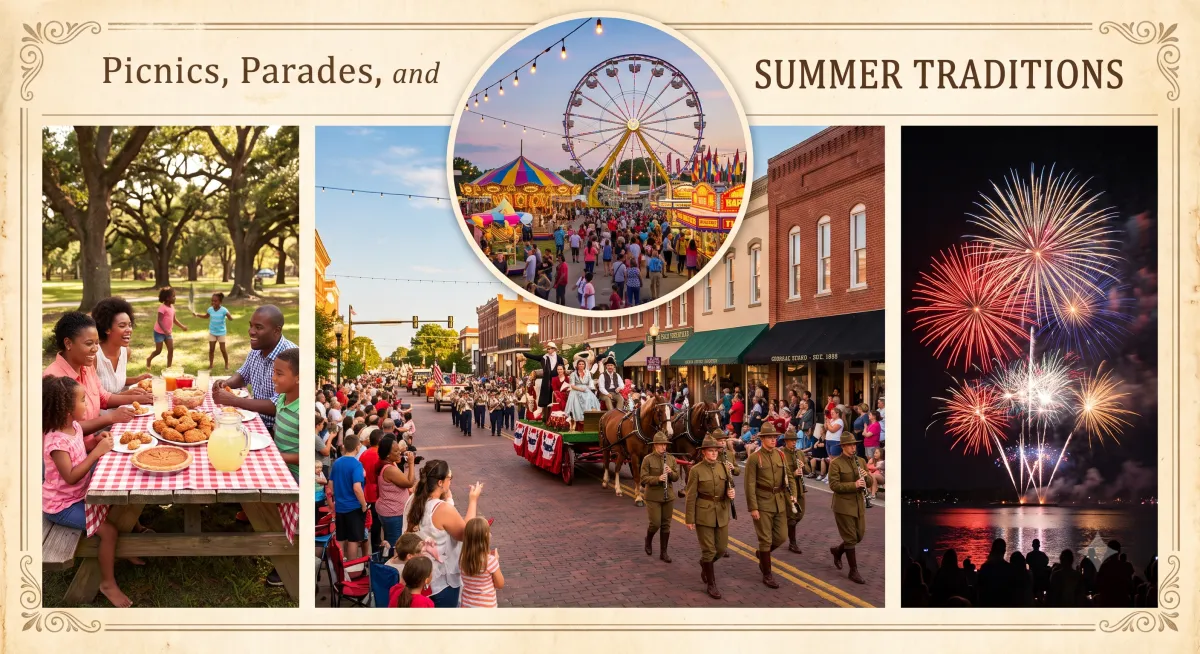
Main Street would be lined five-deep with eager spectators wearing their Sunday best. The procession featured local marching bands sweating in heavy wool uniforms, meticulously polished horse-drawn fire engines, veterans proudly displaying their old service medals, and "Floral Automobiles"—early cars completely covered in real, fresh-cut summer flowers from local gardens.
Following the parade, the entire community shifted its energy to a local park, orchard, or forest grove for a massive communal picnic. Long wooden tables groaned under the collective weight of home-cooked food. Because these gatherings took place decades before electricity and portable refrigeration, the menu had to be carefully planned for the heat:
Mainstays: Crispy fried chicken and fresh breads wrapped in clean linens.
Natural Coolers: Potato salad kept cool by packing the serving jars tightly and submerging them directly into adjacent cold running streams.
Desserts: Rows of homemade fruit pies and structural layer cakes.
For children, the absolute crown jewel of the event was hand-cranked ice cream. Siblings and cousins took turns sitting on top of the canvas blankets to weight it down while turning the heavy iron crank of a wooden bucket packed with rock ice and salt.
Traditional Holiday Foods and Family Rivalries
Food was the ultimate centerpiece of these mid-summer gatherings, and certain recipes became entirely synonymous with the holidays themselves. In many families, specific summer dishes sparked friendly, generational rivalries that lasted for decades.
Grandma might have been famous for her secret strawberry-rhubarb pie crust recipe, while an uncle took fierce pride in his proprietary spice rub for slow-cooked backyard barbecue. Regional geography heavily dictated what hit the table. In coastal Canadian communities, Dominion Day was traditionally celebrated with a fresh, elegant feast of Atlantic salmon paired perfectly with new potatoes and early summer garden peas.
Meanwhile, in the American Midwest, no Fourth of July was considered complete without dozens of ears of sweet corn roasted directly in their green husks over hot hardwood coals. These highly seasonal flavors were deeply anticipated all year long, marking the true arrival of mid-summer agricultural abundance.
Deep Dive: Genealogy Records to Highlight
To find the specific, localized stories of how your ancestors’ communities celebrated, you must look past standard census sheets and focus on historical records that capture local culture, social movements, and small-town community gossip.
1. Historical Newspaper Archives
Small-town newspapers are the absolute best resource for reconstructing historic holidays. Search digital archives for the week immediately following July 1st or July 4th. You will find exhaustive, column-length articles detailing the exact schedule of events, the names of parade marshals, and even the winners of community competitions. It is not uncommon to find gold nuggets like: "Miss Mary Evans won first prize in the three-legged race at the Dominion Day picnic," or "The Smith family hosted twenty out-of-town relatives for a magnificent Fourth of July barbecue."
2. Community and County History Books
Published in large numbers during the late 19th and early 20th centuries, local county histories often contain entire legacy chapters dedicated to how early pioneer settlers established holiday traditions, including details about the very first town celebrations ever held in the region.
3. Family Letters and Historical Diaries
Look for mentions of holiday preparations and domestic tasks in family documents. An ancestor’s diary entry from July 4, 1885, might simply state: "Weather very hot. Took the team to town for the speeches. Children enjoyed the firecrackers. Ice cream in the evening." This brief, handwritten note provides an authentic, unfiltered glimpse into their emotional and daily world.
4. Scrapbooks and Ephemera
Our ancestors loved to save physical souvenirs from happy days. Look through inherited family scrapbooks for vintage holiday postcards, printed parade rosters, silk ribbons, or paper tickets to community holiday dances, pageants, and evening concerts.
Step-by-Step: Preserving Modern Celebration Memories
While we spend a lot of time uncovering the celebrations of the past, we are actively creating the genealogy records of the future right now. Use this strategic framework to properly document your family's modern July traditions for future generations:
Capture the "Behind-the-Scenes" Details: Don't just take a sterile photo of the family lined up, posed, and smiling. Photograph the messy kitchen counters during the frantic morning meal prep, the smoke rising from the backyard grill, and the chaos of children waiting on blankets for the fireworks to start. These candid moments look exactly like the historic diary entries we actively hunt for today.
Write Down the "Family Recipes": If your family has a signature dish that appears every single July, take five minutes to type out the recipe. Note who originally brought it to the family table, and detail any creative changes made to it over the years.
Create a Holiday Mini-Memory Capsule: At the end of the holiday, save a physical copy of your town's official parade program, a custom printed napkin, or a flyer from the community fireworks show. Place these physical items into an archival-safe sleeve inside your family history binder.
Digitize and Tag Immediately: Don't let your holiday photos languish unorganized on your smartphone. Upload them to a secure cloud drive, label them with the exact year and location, and tag the family members present so future genealogists don't have to guess who they are looking at decades from now.
Sparks Flying Across Time
Every time I watch a display of fireworks painting brilliant, temporary strokes of red, green, and gold across a warm July night sky, I look around at the illuminated faces of my family. In those bright, fleeting moments, I often think about how my great-grandparents stood in open fields and public city parks doing the exact same thing a century ago.
The underlying technology behind the fireworks may have evolved from simple black powder into complex computer-timed scripts, but the collective gasp of wonder from the crowd remains exactly the same.
When we celebrate these mid-summer holidays, we are participating in a beautiful, sensory form of historical time travel. We are eating the same sweet summer fruits, listening to the same style of uplifting brass music, and feeling the same warm summer breeze that our ancestors did. It is a powerful reminder that our family history isn't just a collection of old, static stories trapped in a dusty archive—it is a living, breathing tradition that we carry forward with pride every single summer.
Conclusion & Call to Action
Our ancestors' national celebrations were more than just days off from grueling manual work; they were essential, hard-won moments of community connection, family bonding, and pure collective joy. By exploring these vibrant holiday traditions through old newspapers, photographs, and diaries, we add a beautiful layer of celebration, color, and humanity to our family tree.
Now, it’s your turn: How does your family celebrate Canada Day or the Fourth of July? Do you have an heirloom recipe or a specific neighborhood park you visit every single year without fail? Leave a comment below and share your favorite summer holiday traditions with us!