The Right Name, Wrong Ancestor
The Right Name, Wrong Ancestor
One of the most unsettling moments in genealogical research is discovering that the ancestor you have been researching may not be your ancestor at all.
I learned this lesson during one of my own research projects. I came across another family tree that appeared to have already solved a problem I was working through. The name was right, the dates were right, and the location was consistent with what I knew about the family. The researcher had also taken the family several generations further back than I had been able to go.
It was tempting to accept the work that had already been done. After all, genealogical research takes time, and when someone else appears to have already made the connection you are trying to establish, it is easy to think you have been handed a gift.
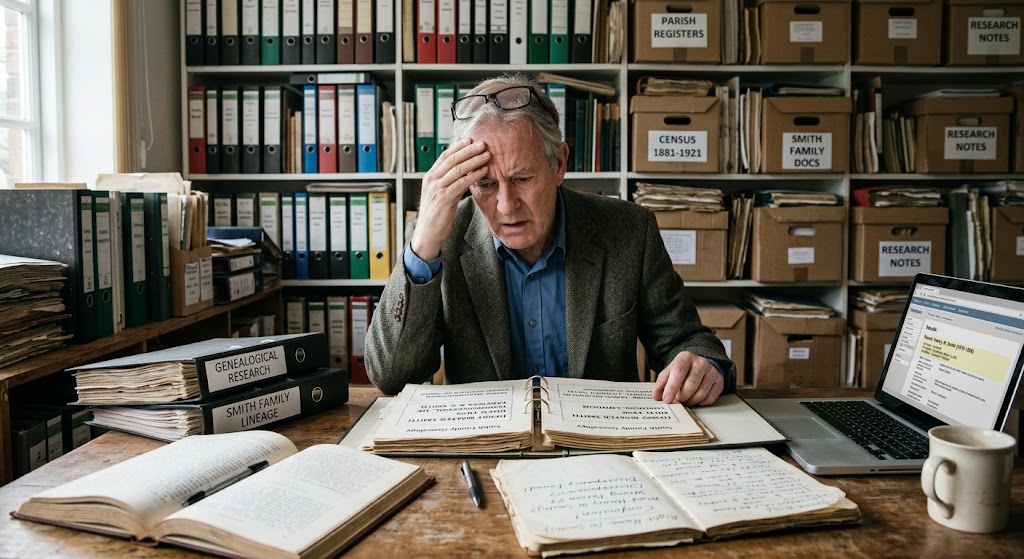
Instead, I began checking the information against the records I could find. That was when the first questions appeared. A detail didn't quite fit. Then another. Nothing was dramatic enough to immediately dismiss the connection, but there were enough inconsistencies to make me slow down and look more carefully at the person I was researching.
Eventually, I realized what had happened. The person I had been following was real. The records were real. The family was real.
They were the same family, but the wrong branch of the family tree.
That experience changed the way I look at other people's family trees, and it taught me one of the most important lessons I have learned in genealogy: a name is not an identity.
When the Right Name Leads You in the Wrong Direction
It is surprisingly easy to make this mistake.
Families reused names. Fathers named sons after themselves. Children were named after grandparents. Cousins could carry the same given name and surname and live in the same community. Add spelling variations, incomplete records and the occasional indexing error, and distinguishing one person from another can become difficult. Naming traditions play a huge role in naming children which sometimes is the challenge, at least it was in my case.
The problem becomes even greater when the person you are looking for has a common name.
Imagine finding a William Smith born around 1845 in the same county where your William Smith was supposed to have lived. His age is close, his occupation seems reasonable and he is married to a woman with the right first name. You find him in a census, then find his marriage, his children and eventually his death.
Everything appears to fit. Except that there may have been two William Smiths.
The records you found may be perfectly accurate, but if they belong to the other William Smith, you have quietly stepped onto someone else's family line.
That is what makes this kind of error so dangerous. There is no obvious mistake to alert you. Instead, each new record seems to strengthen the story you have already accepted. And it means a lot of back work to undo the mistake.
A Family Tree Can Be Very Persuasive
Online family trees make this easier to do because someone else may already have built much of the path for us.
I have found other people's research extremely useful. A family tree can introduce a surname I had never encountered, suggest a possible relationship, point me toward a new location or lead me to a record I might not have found on my own.
The problem isn't using that information. The problem is stopping there.
When I found the tree that sent me down the wrong path, the information was persuasive precisely because it seemed so complete. The researcher had already made connections, added dates and identified generations that I was still trying to establish.
It would have been very easy to copy the information into my own tree and continue researching from there. This is what I did, Every subsequent discovery was built on the wrong foundation. It wasn’t until my research made me stop and question what I was doing. Something felt off, so I worked backwards correcting the data to remove the wrong ancestor.
The Details That Tell Us Who Someone Really Was
The experience made me much more conscious of the difference between finding a name and identifying a person.
When I encounter a possible ancestor now, I want to see how that person fits into the wider family and community. The birth date or age is important, but it is only one piece of the puzzle. I look at the birthplace, residence, occupation, spouse, children, parents and siblings. If the person moved, I want to understand whether that movement makes sense in the context of the rest of the family.
Sometimes the smallest detail provides the answer.
A child may have been born in a different county. A wife's maiden name may distinguish two men with the same surname. An occupation may show that two apparently identical people actually led very different lives. A neighbour may turn out to be a brother or an in-law. A witness on a marriage record may provide the family connection that was missing from the census.
None of these details necessarily proves an identity on its own. Together, however, they allow us to build a much stronger picture of the individual we are researching.
That is particularly important when two relatives share the same name.
The question isn't simply, “Can I find a record for this person?”
It is, “How do I know this record belongs to my person?”
That is a much more important question.
When a Fact Becomes a Fact
There is another lesson hidden in this experience.
When information appears in several family trees, it can begin to feel like established fact. We see the same birth date, the same parents or the same marriage recorded again and again, and eventually we stop questioning it.
But repetition is not the same as verification.
Ten family trees containing the same unsourced information do not provide ten independent sources. They may all have copied the same original entry, and that original entry may have been based on an assumption rather than a record.
This is why I pay much more attention now to where information came from than to how often I see it repeated.
If a family tree gives me an exact birth date, I want to know whether it came from a birth registration, baptismal record, Bible, obituary or some other source. If a parent-child relationship has been added, I want to know what record supports that relationship. And whenever possible, I want to look at the record myself.
Not because I assume another researcher is wrong, but because I want to understand exactly what the record tells me. Sometimes the original document confirms the information. Sometimes it reveals a small discrepancy that needs further investigation. And sometimes it provides the clue that shows two people with the same name have been confused.
What I Learned From Getting It Wrong
I don't look back at that research experience as wasted time. In fact, it changed the way I research.
I still look at other people's family trees, follow the leads they provide. Appreciate the enormous amount of work that other genealogists make available to us. The difference is that I no longer treat their conclusions as my evidence.
If another researcher has identified the parents of a possible ancestor, I can investigate those parents. If they have found a marriage, I can look for the original record. If they have traced the family into another generation, I can use their work to determine where I should search next.
Their research gives me direction.
The records determine whether I have arrived at the right destination.
That distinction has become one of my most useful habits in genealogy.
A Challenge for Your Own Family Tree
There is a simple way to test this in your own research.
Choose one relationship in your family tree that you accepted primarily because another researcher had already made the connection. It could be a parent, a spouse, a child or an entire branch of the family.
Now go back and see if you can establish that connection from the records yourself.
Don't be satisfied with finding the same name. Look at the surrounding details. Does the age fit? Is the birthplace consistent? Does the spouse match? Are the children the same? Does the family live where you would expect them to? If there is another person with the same name, what evidence distinguishes the two?
You may discover that the connection is exactly right, and you will have added stronger evidence to your research.
You may find that a date or relationship needs correcting.
Or you may discover what I discovered: that you have been following a real person, with real records and a real family, but the wrong ancestor.
If that happens, don't consider the research wasted. You have caught the mistake before it travelled further into your family tree, and you now have a much better understanding of where the correct trail may lead.
That, after all, is one of the realities of genealogy. Research doesn't always move in a straight line. Sometimes we follow a promising path only to discover that it belongs to someone else. The important thing is being willing to stop, question what we have assumed and start following the evidence again.
Other people's family trees can be wonderful places to begin. They can open doors, provide leads and introduce us to possibilities we might never have considered.
But they are not the final authority.
The lesson I took from my own experience is simple:
Use someone else's family tree as a clue, not as evidence.
Because in genealogy, having the right name is only the beginning.
The real challenge is making sure you have found the right ancestor.