Where every family story begins
Where Every Family Story Begins
Every family story has a beginning.
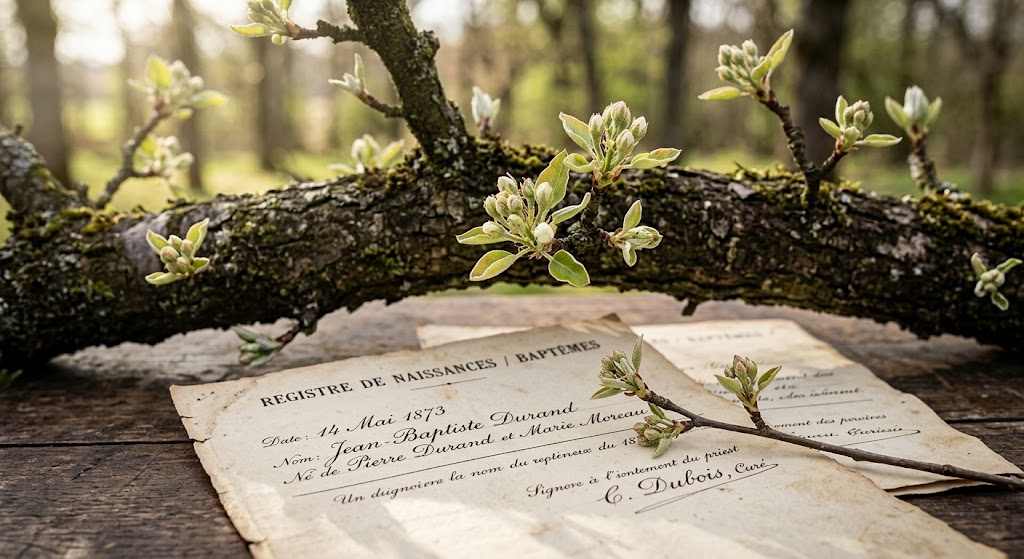
In nature, spring marks the beginning of a new cycle. Tiny buds appear on bare branches, seedlings push through the soil, and the landscape slowly comes back to life. There is a sense of possibility in those first signs of growth.
Our ancestors had beginnings too.
A birth, a baptism, the arrival of a new baby in a household—these are the moments where a person's story begins to take shape. For genealogists, they are also the places where our research often begins.
But finding an ancestor's birth date is only the first step.
The real question is: What can the records tell us about the world into which that child was born?
Start with the birth
Birth records are among the most important documents in family history research. Depending on the time and place, a registration may provide the child's name, date and place of birth, parents' names, father's occupation and sometimes the family's address.
But records vary considerably by jurisdiction and time period.
A birth registration from one province may contain information that isn't found in another. Earlier records may be particularly sparse, while later registrations can provide considerably more detail.
This is why it is important to understand the record system in the place and period you are researching rather than assuming every birth record will contain the same information.
The document tells you what was recorded.
The historical context helps you understand what it means.
Look for the family around the child
One of the easiest mistakes in genealogy is to focus so closely on an individual that we overlook the household.
A census record can be particularly valuable here.
Instead of simply confirming that a child existed, a census can place that child among parents, siblings and sometimes other relatives or household members. It can provide ages, occupations, places of birth, religion and other information depending on the census and jurisdiction.
Suddenly, the child becomes part of a family.
And that family becomes part of a community.
This is where genealogy begins to move beyond collecting names and dates.
Follow the child through the early years
Once you know where and when a child was born, look for evidence of what happened next.
Baptismal or church records may confirm a birth and identify parents or sponsors. School records can tell us where a child lived and sometimes reveal a family's movement from one community to another. Census records can show changes in the household over time.
Directories, newspapers and local records may also provide clues.
A school photograph might put a face to a name.
A newspaper announcement might tell us that a child won a school prize.
A directory might show where the family lived.
None of these records necessarily tells the whole story.
Together, however, they begin to create a picture.
Don't overlook the siblings
Sometimes the record you need is not about your ancestor at all.
A sibling's birth registration may provide information about the parents. A younger child's baptismal record may identify a church the family attended. A sibling's marriage record may reveal the family's location years later.
This is one of the reasons I like to think of genealogy as following a family rather than simply following an individual.
Families leave records collectively.
When one branch becomes difficult to follow, another may provide the clue that brings the whole family back into focus.
What was happening around them?
There is another layer to those early years that genealogists sometimes overlook.
What was happening in the community when your ancestor was growing up?
Was the town expanding? Was a railway being built? Were families arriving from another country? Was an industry opening or closing? Was there a major economic event that affected employment?
Local newspapers, historical societies, maps, directories and community histories can help answer these questions.
Imagine discovering that your great-grandfather's family moved when he was eight years old. The census confirms the move, but a newspaper reveals that a local mine had closed around the same time.
Now the move has context.
You haven't simply found another address.
You've found part of the story.
The importance of not assuming
Beginnings can also be where genealogical assumptions take root.
Perhaps a family has always said that an ancestor was born in a particular town. Perhaps everyone believes the family arrived in Canada in a certain year. Maybe an old photograph has been identified as a particular relative.
These clues are valuable.
But they are still clues.
Whenever possible, look for the record that supports the family story.
Sometimes the record will confirm what you have been told.
Sometimes it will add a surprising detail.
And occasionally, it will send you in an entirely different direction.
That isn't a failure.
It is research doing exactly what it is supposed to do.
From a small beginning to a larger story
A new family tree can look a little like a garden in early spring.
At first, there may be only a few names. You add a birth record here, a baptism there, perhaps a census entry or school record.
Slowly, something begins to emerge.
Parents become people rather than names.
Children become siblings rather than individual entries.
A house becomes an address where several generations may have lived.
A community becomes more than a dot on a map.
And one small record can lead to another.
That is the beauty of researching the beginning of a life.
We aren't simply trying to discover when someone was born.
We are trying to understand the circumstances into which they were born and the family and community that surrounded them.
A Genealogist's Takeaway
Choose one ancestor whose early life is still a little hazy.
Start with the basics:
Where and when were they born? Who were their parents? Where did the family live? Who else was in the household? Where were the children baptized or educated?
Then identify the records that could answer those questions.
Don't try to find everything at once.
Begin with one record and let it lead you to the next.
Just as a single spring bud is the beginning of an entire season of growth, one well-chosen record can be the beginning of an entirely new family story.