Tracing Women Maiden Names and Name Changes in Your Family Tree
Tracing Women: Maiden Names and Name Changes in Your Family Tree
There is a moment in almost every genealogist’s journey when the line simply… stops.
You follow a male ancestor back generation after generation. Census to census. Land deed to will. The path is steady and visible.
And then you arrive at a woman.
She appears in a marriage record under one name.
In a census under another.
In a child’s baptism under a slightly altered spelling.
And in her obituary — if you are lucky — under yet another variation entirely.
Her trail fragments.
This is where many researchers feel defeated.
But this is also where some of the most rewarding discoveries begin.
Let me introduce you to Eliza.
Meet Eliza Martin — Or Was It Marten? Or McLeod?
Eliza first appears in the 1871 census of Nova Scotia as “Eliza Martin,” age 28, wife of fisherman James McLeod.
Simple enough.
But when you search for her birth record, nothing appears under “Eliza Martin.”
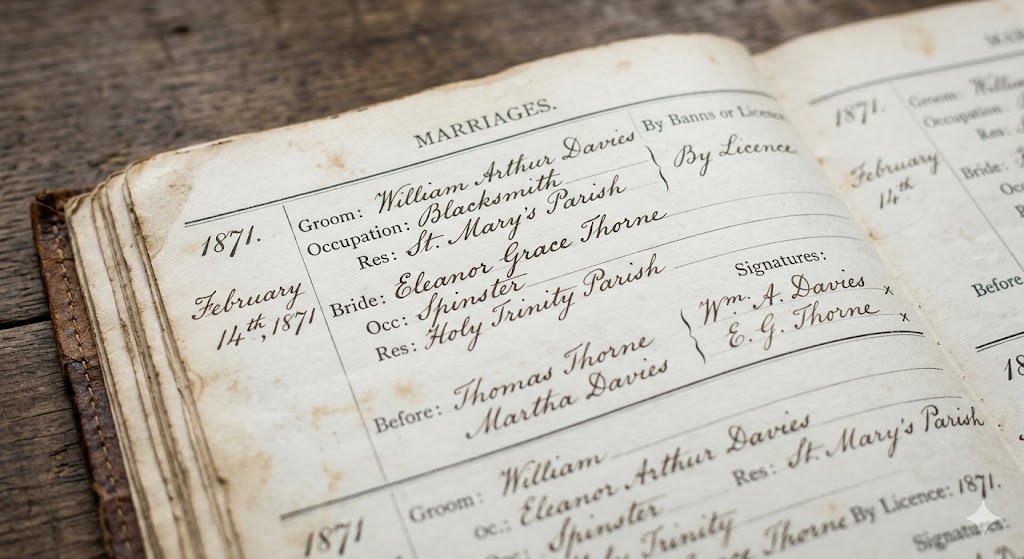
A marriage record reveals she married James in 1865 — but her name is recorded as “Elizabeth Marten.”
A baptismal record for her eldest son lists her as “Eliza McCloud.”
By the time of her death in 1912, her obituary refers to her as “Mrs. J. McLeod, formerly of the Martin family of Pictou County.”
Martin. Marten. McLeod. McCloud.
Which one is correct?
All of them — and none of them.
Tracing women through maiden names and name changes requires us to loosen our grip on rigid spelling and rethink how identity functioned in earlier centuries.
Why Maiden Names Matter So Much
A woman’s maiden name is the bridge to an entirely new branch of your family tree.
Without it, you are genealogically stranded.
Maiden names unlock:
Her parents
Her siblings
Her ancestral homeland
Her ethnic or cultural origins
Her inheritance rights
Extended kinship networks
In many cases, one correctly identified maiden name can expand your family tree by dozens — sometimes hundreds — of individuals.
And yet maiden names are often the most elusive detail in women’s records.
The Name Change Problem
Historically, when women married, they adopted their husband’s surname. Legally, socially, and religiously, this change was assumed and rarely explained in records.
Complications include:
Phonetic spellings (Marten vs. Martin)
Clerical errors
Illiteracy (many women could not verify spellings)
Language shifts during immigration
Cultural naming conventions (especially in French, Irish, Scottish, and Eastern European families)
In some cultures, women retained their maiden names in church records but used married names socially. In others, surnames evolved with patronymic systems (such as Scandinavian naming patterns).
Understanding cultural context is critical.
Clue #1: Marriage Records — Civil and Church
Eliza’s civil marriage registration listed her as “Elizabeth Marten.” But the church marriage register included her parents’ names: John Marten and Sarah Fraser.
That one document confirmed her maiden identity.
Always seek:
The original marriage register (not just an index)
Church versions in addition to civil registrations
Witness names (often siblings or cousins)
Marriage records are the most direct route to a maiden name — but not the only one.
Clue #2: Children’s Records
Eliza’s third child, baptized in 1870, listed his mother as “Eliza Fraser Marten.”
There it was again — her mother’s surname preserved as a middle name.
Many families embedded maternal surnames into children’s middle names as a way to preserve lineage.
Look carefully at:
Middle names
Godparents
Baptismal sponsors
Naming patterns among daughters
Daughters were often named after maternal grandmothers — a powerful clue when maiden names are missing.
Clue #3: Death Certificates and Obituaries
By the early 20th century, death certificates frequently included a section for parents’ names.
Eliza’s death certificate listed her father as “John Martin” and her mother as “Sarah Frazier.”
Not perfect spelling — but recognizable.
Obituaries can also reference:
“Daughter of the late…”
“Native of…”
Survived by siblings (who retain the maiden surname)
Even imperfect information can confirm direction.
Clue #4: Land and Probate Records
Here’s where Eliza’s story took an unexpected turn.
When her father, John Marten, died in 1883, his probate file listed:
“To my beloved daughter Eliza McLeod…”
Suddenly, the surname shift was visible within a single document.
Probate records frequently list married daughters under their married names while still identifying them as children of the deceased.
This cross-reference is genealogical gold.
If you know a father’s name but cannot confirm a daughter’s maiden surname, search probate files for estate distributions.
Clue #5: Census Strategy — Think Sideways
Census records can be misleading, but they also offer context.
In 1861, before her marriage, a 19-year-old “Elizabeth Martin” appears in the household of John and Sarah Martin in Pictou County.
The ages match.
The geography matches.
The siblings’ names later appear as baptismal sponsors for her children.
You are not always looking for certainty. You are looking for patterns.
Genealogy is often the art of assembling consistent evidence across multiple sources rather than relying on a single perfect document.
When Women Remarry
One additional complication: remarriage.
If a husband died young, many women remarried — sometimes multiple times. Each marriage produced another surname.
A woman born Elizabeth Marten could appear as:
Elizabeth Marten (birth)
Eliza McLeod (first marriage)
Eliza Grant (second marriage)
Mrs. Thomas Grant (later records)
Without tracking each marriage carefully, researchers may mistakenly believe they are looking at different women.
Always search for:
Widow remarriage records
Children from prior marriages in blended households
Burial plots (often reveal multiple spouses)
What Eliza Teaches Us
By the time her life story was assembled, Eliza was no longer a confusing collection of spellings.
She was:
Daughter of John Marten and Sarah Fraser
Wife of James McLeod
Mother of five
Keeper of maternal naming traditions
A link between two Scottish-descended families in Nova Scotia
Her identity did not disappear when her surname changed.
It simply required patience — and perspective — to uncover.
Practical Strategies for Tracing Maiden Names
If you are stuck:
Obtain the original marriage record.
Search children’s birth and baptismal records.
Review death certificates for parents’ names.
Look for probate files of potential fathers.
Study naming patterns among children.
Track siblings and in-laws.
Search newspapers for marriage announcements.
Be flexible with spelling variations.
Research cultural naming conventions relevant to the region.
Build timelines to ensure you are following one consistent individual.
Above all, do not assume that the absence of a maiden name means it never existed in records. It may simply be recorded somewhere unexpected.
Restoring Her Original Name
There is something powerful about restoring a woman’s maiden name in a family tree.
It is an act of recognition.
It acknowledges that she belonged to a family before she created one. That she carried heritage forward. That her identity was not erased by marriage — only reshaped by it.
During Women’s History Month, consider reviewing the women in your tree.
Do they have full maiden names attached?
Or are they still waiting to be properly identified?
Behind every surname change is a woman who deserves to be remembered in her entirety.
And sometimes, finding her name is the key to unlocking generations.