Immigrant Women The Strength Behind the Suitcase
Immigrant Women: The Strength Behind the Suitcase
There is a photograph tucked away in nearly every family album. Perhaps it is blurred. Perhaps it is yellowed with age. But it carries a weight no document alone can bear.
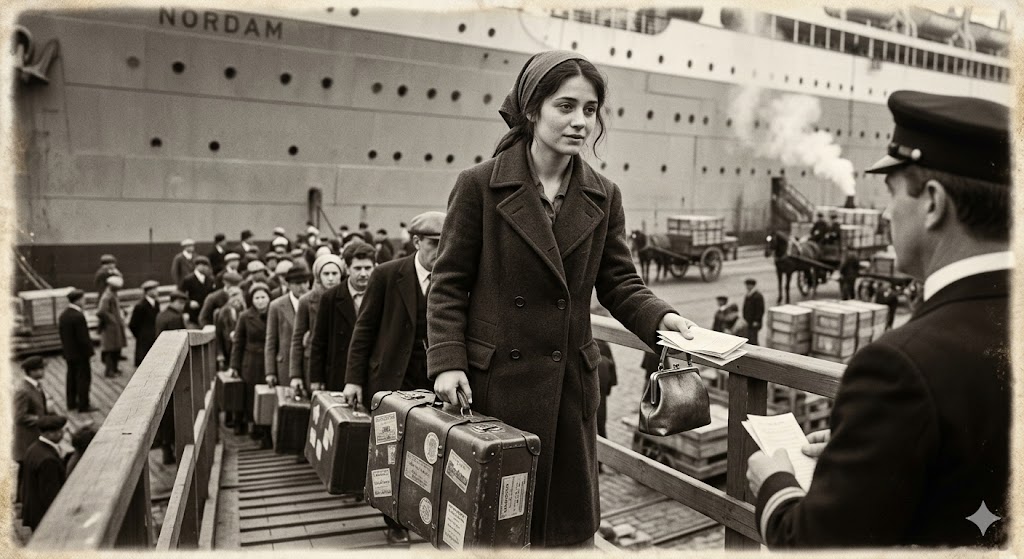
A young woman, clutching a small suitcase, gazes toward a steamship, a train, or an unfamiliar street. She may be smiling — but the smile masks fear, hope, exhaustion, and determination all at once.
For genealogists, these women are more than a symbol. They are ancestors who left everything familiar to build new lives. And yet, in records, their presence is often faint. Names shift. Stories fragment. Trails disappear.
March, Women’s History Month, invites us to uncover these journeys — to honor the women who crossed oceans, navigated borders, and carried the strength of entire families in a single suitcase.
Let me tell you about Sofia Petrova.
Meet Sofia Petrova
Sofia was born in 1888 in Varna, Bulgaria. Her family were modest merchants: a father who sold textiles, a mother who baked bread for the village market.
At 19, Sofia boarded a ship bound for Montreal. Alone.
The passenger list recorded her simply as “S. Petrova, 19, Bulgaria, domestic work.”
Nothing more.
No parents, no siblings, no sense of the home she left behind. Just a young woman, leaving everything familiar, stepping into uncertainty.
The first step in reconstructing Sofia’s story — and the story of countless immigrant women — is recognizing that these minimal records hide immense histories.
Why Immigrant Women Disappear in Records
Women who migrated often appear only in relation to others:
A daughter accompanying a family member
A maid listed under an employer’s household
A wife joining a husband in a distant city
Unlike men, whose immigration records frequently include occupations, property, or military connections, women’s documentation was sparse. Many passenger manifests prioritized marital status and age over heritage or skills.
Then came the additional complications:
Spelling errors of foreign names
Anglicization of surnames
Multiple transits through ports before permanent settlement
Sofia Petrova became “Sophia Peters” in Montreal — a shift that disconnected her from her Bulgarian roots in conventional indexes.
Clue #1: Passenger Lists and Immigration Records
Sofia’s first breakthrough came when a family historian examined original passenger manifests.
Search widely: Check ports of entry, ship manifests, and border crossing records.
Look beyond indexes: Many online databases interpret or truncate names. Original scans reveal fuller details.
Consider spelling variants: “Sofia Petrova,” “Sophia Peters,” “S. Petrowa” — all may refer to the same person.
Even a minor detail — age, occupation, traveling companion — can link scattered records into a cohesive story.
Clue #2: Naturalization and Census Records
By 1911, Sofia appears in Canadian census records:
“Sophia Peters, 23, domestic servant, married to John Peters, 25, carpenter.”
The name change is permanent. Her maiden name is invisible unless we search marriage records.
Naturalization records, however, can reveal her original name, birthplace, and sometimes even her parents’ names.
For immigrant women, these legal documents are lifelines:
Proof of identity before marriage
Connection to birthplaces and homeland
Migration timeline and port of arrival
Every record is a thread, waiting to be woven into a larger tapestry.
Clue #3: Marriage Records
Sofia’s marriage certificate finally gave her a link back to Bulgaria:
Parents: Ivan Petrova and Mariana Dimitrov
Place of birth: Varna, Bulgaria
Witnesses: Two cousins, also immigrants
Marriage records often provide crucial maiden names for women who have altered or anglicized their surnames.
They also provide context: family networks, common migration patterns, and community connections. In Sofia’s case, it confirmed a small Bulgarian enclave in Montreal, which she joined upon arrival.
Clue #4: Community Records and Oral Histories
Immigrant women often left little in government archives. But community archives — church registers, ethnic newspapers, and social clubs — can preserve fragments of their lives.
Sofia became active in the Bulgarian Women’s Club, helping newly arrived families navigate Montreal. Meeting minutes and newsletters mentioned her by her original surname and English-adopted name.
Oral histories, collected decades later from descendants, added vivid details:
Her skill at traditional baking
Her role in teaching English to neighbors
The suitcase she always carried with her trousseau and documents
By combining records with community memory, we begin to reconstruct a fuller life.
Clue #5: Later Life Records
In the 1940s, Sophia’s children registered her original surname as “Petrova” on their own immigration and passport forms, preserving her lineage.
Even when women changed their names, descendants often remembered — a critical genealogical clue.
Tracking women across name changes and migrations may require cross-generational research: look at children, grandchildren, and nieces/nephews for information that confirms identities.
Lessons from Sofia’s Journey
Sofia Petrova was more than a passenger on a ship. She was a connector:
Linking homeland and new land
Preserving cultural traditions
Supporting family networks
For genealogists, the challenge is recognizing that immigrant women are often recorded indirectly, across multiple systems, under multiple names.
Strategies include:
Search all ports of entry, using name variations.
Investigate marriage certificates for maiden names and parents.
Use naturalization records to reconnect altered names to original identities.
Consult community archives and ethnic organizations.
Review census and city directories for clues across decades.
Incorporate oral histories to fill gaps in the documentary record.
Consider following descendants to locate corroborating evidence.
Every document is a breadcrumb. Every story, a path toward recognition.
Restoring Identity
Immigrant women carry invisible histories:
Journeys across oceans
Cultural adaptation
Family rebuilding
They shaped families, neighborhoods, and communities, often with little acknowledgment in the official record.
Finding them in your genealogy research is an act of restoration. It is giving voice to women whose courage and sacrifice underpin your family tree.
Final Thoughts
As genealogists, Women’s History Month reminds us to look more closely. To challenge assumptions. To uncover the women who, like Sofia Petrova, carried the strength of entire generations in a single suitcase.
Their stories are waiting to be found. Their names are waiting to be remembered.