The Merchant Navy
The Merchant Navy: A Different Kind of Service
Remembering the men and women who kept vital supplies moving during wartime—and discovering their stories in our family histories.
Service Beyond the Battlefield
When we remember ancestors who served during wartime, our thoughts often turn to soldiers in uniform, sailors aboard naval vessels and aircrew flying dangerous missions. Yet another group played an essential role in sustaining the war effort: the men and women of the Merchant Navy.
Merchant seafarers carried food, fuel, raw materials, equipment and military supplies on which both civilian populations and armed forces depended. Their ships crossed oceans and navigated dangerous waters, often under the threat of enemy submarines, aircraft and mines. Their work was essential, but their stories may be less familiar to later generations.
For family historians, discovering a merchant seafarer among our ancestors can open a different perspective on wartime service. Instead of beginning with an army regiment or a military personnel file, we may need to investigate ships, shipping companies, seamen’s records, ports and maritime archives.
The first step is understanding what made their service different—and recognising that the maritime contribution to wartime life extended well beyond those who sailed aboard merchant vessels.
Understanding the Merchant Navy
The Merchant Navy was not the same as the Royal Canadian Navy. Merchant ships were commercial vessels that transported goods and passengers, while naval ships were part of a country's armed forces. During wartime, however, merchant vessels became vital to national survival and military operations.
During the Second World War, Allied merchant ships transported enormous quantities of supplies across the Atlantic and other oceans. Convoys travelled together for protection, but the journeys remained hazardous. Ships could be torpedoed, bombed or sunk by mines, and crews faced the possibility of injury, death, capture or being left adrift at sea.
Merchant seafarers were not necessarily members of the armed forces, and their service records may be held separately from military personnel files. This distinction matters when researching an ancestor. A search limited to army, navy or air force records may overlook someone whose wartime contribution was made aboard a merchant vessel.
Nor should we overlook the people who worked behind the scenes. Shipyard workers built, repaired and maintained vessels, while members of naval reserve organisations served in a different capacity. These were distinct forms of work and service, but each contributed to the wider maritime story.
Although the Second World War is an important starting point, merchant seafaring extends across many generations. An ancestor might have worked on commercial vessels during an earlier conflict, in peacetime, or during a later period of military operations. The dates and circumstances of their service will determine which records are most useful.
Begin with What Your Family Knows
Before searching archives, gather the information already available within your family.
Did an ancestor describe himself or herself as a seaman, sailor, deckhand, engineer, cook, steward or radio operator? Did family members remember a ship's name, a port of departure, a voyage overseas or a period spent away from home? Perhaps an ancestor worked in a shipyard or served in a naval reserve. Even a vague recollection may provide a useful starting point.
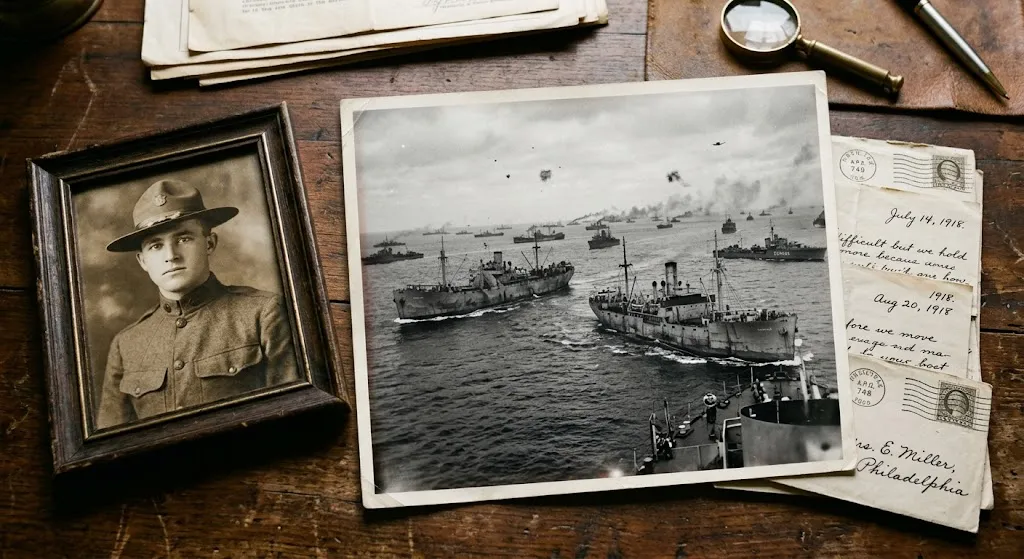
Look for photographs, letters, postcards, certificates, discharge documents, identity books, medals and newspaper clippings. A photograph taken aboard a ship may contain a vessel's name or reveal a uniform, cap badge or other identifying detail. Letters sent from overseas may mention ports, routes, cargoes or fellow crew members.
Record the ancestor's full name, approximate birth date, home address, occupation and any known dates of service. Keep spelling variations in mind, particularly if the person emigrated or worked under a name that was recorded differently in different countries.
Do not assume that an ancestor who went to sea during wartime was automatically a member of the Merchant Navy. Establishing the type of vessel and the nature of the person's employment will help determine the appropriate research path. Similarly, a shipyard occupation or naval reserve record should be investigated through sources suited to that particular experience.
Where to Look for Merchant Seafarers
Library and Archives Canada
Library and Archives Canada (LAC) is a useful starting point for researching Canadian maritime and wartime history. Its military history resources can help distinguish military records from other forms of service, while its archival holdings may provide additional context about Canadian participation in wartime shipping.
Begin with the official research guide:
https://www.canada.ca/en/library-archives/collection/research-help/military-history.html
Search the LAC catalogue for your ancestor's name, but also consider searching for a ship, shipping company, port or maritime subject. Not every relevant record will be indexed under an individual's name.
The National Archives in the United Kingdom
If your ancestor was born in Britain, worked for a British shipping company or served on a British-registered merchant vessel, records held by The National Archives in the United Kingdom may be relevant.
Its collections include records relating to merchant seamen, shipping and wartime maritime activity. The record series and access arrangements depend on the period being researched.
Official website: https://www.nationalarchives.gov.uk/
Maritime Museums and Local Archives
Maritime museums, port archives, historical societies and local libraries can be valuable sources of information. They may hold photographs of vessels, crew lists, shipping records, oral histories or newspaper reports of ships arriving and departing.
If your ancestor lived near a Canadian port, investigate the local maritime history. Halifax, Saint John, Montreal, Quebec City and Vancouver, for example, all have important connections to Canada's maritime and shipping history.
Remember that a port may have been a place of departure or arrival without being the vessel's home port. Follow each clue rather than assuming that a ship remained in one location.
Follow the Ship, Not Just the Seafarer
One of the most useful strategies in maritime genealogy is to research the vessel itself.
If a family document identifies a ship, record its exact name and look for alternative spellings or names used at different times. Ships could be sold, transferred between companies, renamed or registered in different countries.
Once you have identified a likely vessel, investigate its history. Was it part of a wartime convoy? Did it transport particular cargoes? Was it damaged or sunk? Did it serve on a regular route between Canadian, British or other ports?
Convoy records, ship histories, newspapers and maritime databases may help reconstruct the circumstances in which an ancestor worked. If the vessel's movements can be established, you may be able to understand some of the journeys and risks the crew experienced.
Be careful not to confuse the history of a ship with the documented experience of an individual. A vessel may have sailed through dangerous waters, but further evidence is needed to establish whether your ancestor was aboard during a particular voyage.
When Family History Becomes a Personal Story
My own interest in maritime history is rooted in my grandfather's experiences in Scotland. In my book, Waves of Steel, I explored his working life in the shipyards and his time with the Royal Volunteer Naval Reserve.
His story reminds me that the maritime contribution to wartime life extended beyond those who sailed aboard merchant vessels. Shipyard workers helped build and maintain the vessels on which so much depended, while members of the Volunteer Naval Reserve served in a different capacity. Although these experiences were distinct from Merchant Navy service, they formed part of the wider story of the people whose skills, labour and commitment supported life at sea.
Writing Waves of Steel also reinforced for me the value of looking beyond a family tree's names and dates. By following the evidence and placing an ancestor's experiences within their historical setting, we can begin to understand not only what they did, but also the world in which they lived.
Your own family may hold a similar story. An occupation, a service record, an old photograph or a few words passed down through generations may be the starting point for discovering an ancestor's place in a much larger history.
Bring the Story Back to the Family Tree
Once you have gathered evidence, connect the maritime history to your ancestor's wider life. Establish where they lived before going to sea, identify the vessels on which they worked, and trace what happened after their maritime career ended.
Use census records, passenger lists, immigration files, civil registration, newspapers and family correspondence to place the seafarer within the family and community. If a ship's name appears in a letter or photograph, preserve that detail alongside the source and the date.
Distinguish confirmed facts from family memories and reasonable possibilities. A documented crew list, for example, may establish that someone served aboard a particular ship, while a family story may suggest why they chose a life at sea. Both can be valuable, but they represent different kinds of evidence.
By bringing these sources together, we can move beyond a name and an occupation to understand the circumstances of a person's life. We may also discover connections between occupations, military service, migration and the communities our ancestors left behind.
Your Research Challenge
Choose one ancestor who worked at sea, whether during wartime or in peacetime. Begin by recording their name, dates, occupation and any known ship names. Search the available family documents before expanding your investigation to archival and maritime sources.
If you cannot identify a vessel, look for indirect clues in census records, newspaper notices, employment documents or correspondence. If your ancestor worked in a shipyard or served in a naval reserve, investigate those experiences separately rather than assuming they were part of the Merchant Navy.
Record each source you consult and note which questions remain unanswered.
You may discover that your ancestor's maritime service was connected to a major historical event. Equally, you may uncover a quieter story of long voyages, hard work and family members who waited at home.
Remembering a Different Kind of Service
Remembrance is not limited to those who fought on land, served in naval combat or flew military aircraft. It also includes the people who carried essential supplies across oceans, built and repaired ships, and contributed through other forms of maritime work and service.
For family historians, the Merchant Navy reminds us to look beyond familiar military categories. Our ancestors contributed in different ways, and the records that preserve their stories may be found in unexpected places.
Sometimes the path to a forgotten family story begins not with a battlefield, but with the name of a ship—or with the discovery of an ancestor whose working life connected them to the sea.