The Stories Only Grandparents Can Tell
The Stories Only Grandparents Can Tell
As family historians, we spend countless hours searching through census records, birth registrations, marriage certificates, newspapers, and cemetery records. These documents help us build the framework of our family tree, providing names, dates, and places. Yet even the most detailed records often leave an important question unanswered: Who were these people really?
The answer is often found in the stories that only grandparents can tell.
Whether they are biological grandparents, step-grandparents, adoptive grandparents, or beloved elders who have become part of the family, older generations possess a treasure trove of memories that rarely appear in official records. Their stories provide context, personality, and meaning to the names on our charts. They tell us not only where our ancestors lived, but how they lived, what they valued, and how they overcame challenges.
As Alberta celebrates Seniors' Week this June, it is a fitting time to recognize the invaluable role grandparents play in preserving family history.
More Than Names and Dates
Genealogy often begins with collecting facts. We search for birth dates, marriage locations, immigration records, and military service files. While these records are essential, they rarely reveal the everyday experiences that shaped our families.
A census may tell us that a family lived on a farm in 1941. A grandparent can tell us what it felt like to wake before dawn to milk cows, how children helped during harvest season, and what special meals were prepared after a successful crop year.
A military record may indicate that a relative served overseas during wartime. A grandparent may remember the letters that arrived from overseas, the anxiety of waiting for news, or the celebrations that followed a loved one's safe return home.
These details transform family history from a collection of documents into a living story.
Witnesses to History
One of the most remarkable aspects of speaking with grandparents is their connection to historical events.
Many of today's seniors have witnessed tremendous social, technological, and cultural changes during their lifetimes. They remember a world before the internet, smartphones, and social media. Some may recall life during the Second World War, the post-war economic boom, the arrival of television, or significant local events that shaped their communities.
For future generations, these memories will become firsthand historical accounts.
Imagine being able to tell your grandchildren not only that your family lived in Alberta during a particular era, but also how your grandparents experienced that time. Their personal perspectives can help future generations understand history through the eyes of someone they know and love.
Stories Hidden in Everyday Life
Not every family story involves dramatic historical events. In fact, some of the most meaningful memories come from ordinary moments.
Grandparents may remember:
Family traditions that are no longer practiced
Childhood games played before modern technology
Favourite recipes handed down through generations
Community celebrations and local festivals
School experiences and friendships
First jobs and early careers
Courtship stories and wedding traditions
Holiday customs and family gatherings
These seemingly small details often become the stories descendants cherish most.
Many families discover that traditions they assumed had always existed actually originated with a particular grandparent or great-grandparent. Understanding these origins strengthens our connection to family customs and helps preserve them for future generations.
Asking the Right Questions
Many people want to record family stories but are unsure where to begin. The good news is that grandparents do not need to provide a complete autobiography in a single conversation.
Often, the best stories emerge through simple questions.
Consider asking:
What is your earliest memory?
What was your childhood home like?
Who was the most influential person in your life?
What family traditions were important when you were growing up?
What was school like for you?
How did you meet your spouse?
What challenges did your family face?
What accomplishments are you most proud of?
What advice would you like future generations to remember?
Open-ended questions encourage storytelling and often lead to unexpected discoveries.
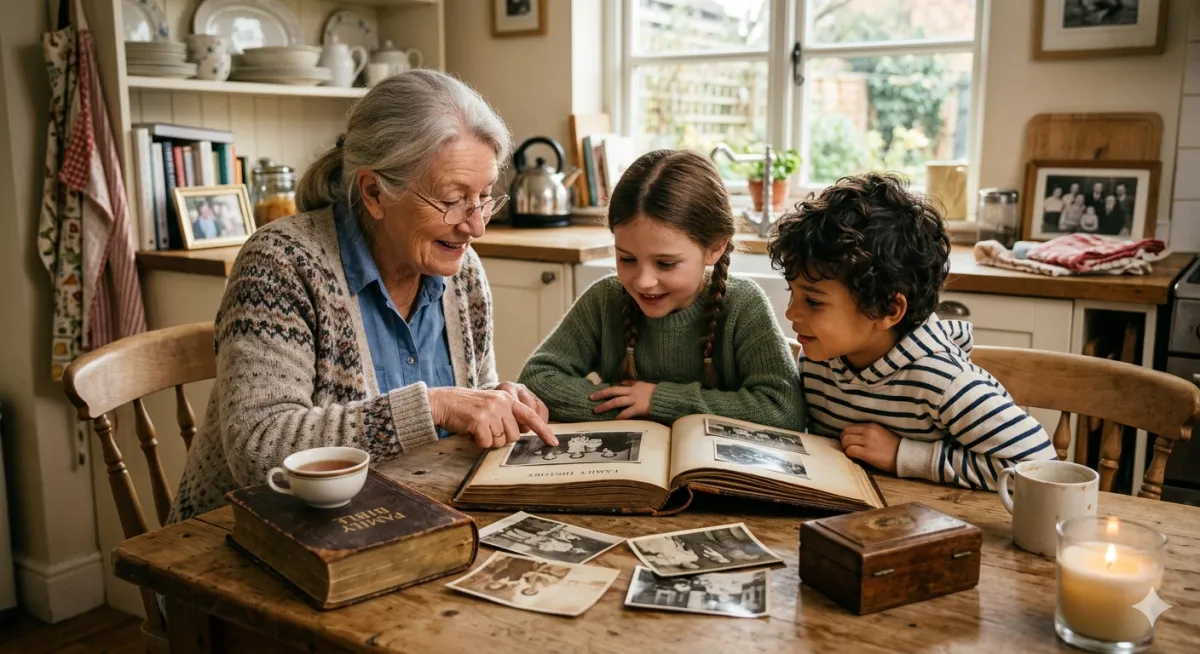
Sometimes a photograph, family heirloom, or newspaper clipping can spark memories that might otherwise remain untold.
The Value of Recording Memories
For centuries, family stories were passed orally from one generation to the next. While oral traditions remain important, modern technology offers new opportunities to preserve these memories.
Consider recording interviews using a smartphone, tablet, or digital recorder. Video recordings can be especially valuable because they capture facial expressions, gestures, and personality alongside the spoken words.
If recording is not possible, taking notes during conversations can still preserve valuable information.
Remember to label recordings carefully, including:
The interview date
The name of the person being interviewed
The location
Key topics discussed
Future family historians will appreciate having this context.
Preserving More Than Facts
One of the greatest gifts grandparents can provide is insight into family values.
Documents can tell us where our ancestors lived and worked, but grandparents often explain why important decisions were made.
Why did the family move across the country?
Why did an ancestor leave their homeland?
How did previous generations cope with hardship?
What beliefs guided family decisions?
These answers help us understand the motivations and character of our ancestors.
They also reveal recurring themes that may still influence our families today—resilience, service, faith, education, entrepreneurship, or community involvement.
When Stories Differ
Family historians sometimes discover that relatives remember events differently.
This is completely normal.
Memories are shaped by personal experiences, perspectives, and the passage of time. Rather than viewing differing accounts as problems, consider them opportunities to gain a richer understanding of family history.
A family event may be remembered differently by siblings who experienced it together. Each perspective adds another layer to the story.
Recording multiple viewpoints helps preserve the complexity of real family experiences.
Starting Today
Many people assume they will have time later to ask questions and record family stories. Unfortunately, opportunities can disappear unexpectedly.
The best time to begin is now.
Even a short conversation can uncover memories that might otherwise be lost forever. A single photograph can inspire an hour of storytelling. A simple question can reveal family connections that no document could ever provide.
As family historians, we often focus on finding records from the distant past. Yet some of the most valuable sources of information are sitting across the dinner table, ready to share memories that exist nowhere else.
A Legacy Worth Preserving
This Seniors' Week, consider reaching out to a grandparent, senior relative, or family elder. Ask about their childhood, their experiences, and the lessons they have learned throughout their lives.
Listen carefully.
Record what you can.
Preserve their words.
Long after documents fade and photographs lose their names, these stories will continue to connect future generations to the people who came before them.
After all, family history is not only about discovering where we came from. It is about preserving the voices that help us understand who we are.
Genealogy Challenge for June: Choose one grandparent, senior relative, or family elder and ask three questions about their childhood. Record their answers and add them to your family history collection. You may be surprised by the stories waiting to be discovered.