Walking in Their Footsteps: Travelling to Your Ancestral Home
Walking in Their Footsteps: Travelling to Your Ancestral Home
There is something powerful about returning to a place that has been part of your family story, even if you have never been there before.
For years, an ancestral place may exist only as a name in a record or a location on a map. You may know that your great-grandmother was born in a particular village, that your grandfather left Scotland for Canada, or that generations of your family lived in the same parish. You can study the records, look at old photographs and read about the community, but there is still something missing. You have never actually stood there.
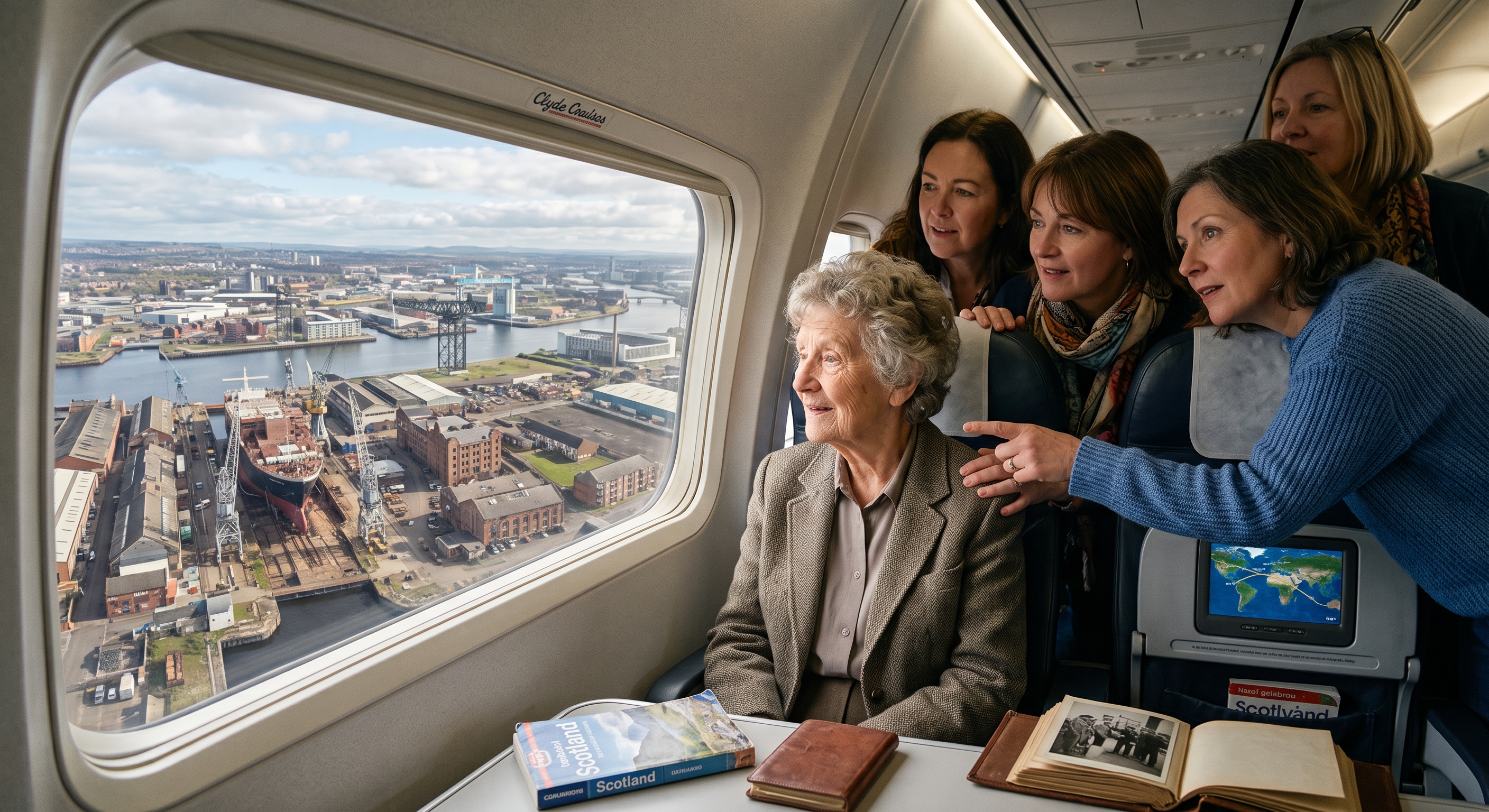
In 2005, my cousins had the opportunity to take my aunt back to Scotland to revisit the places connected to her family. She had immigrated to Canada and had never returned. For her, this was not simply a genealogy trip or a chance to see another country. She was returning to a place that had been part of her life before Canada, and to the family history that had travelled with her when she left.
That experience has stayed with me because it illustrates something important about ancestral travel. We do not all travel to our ancestral homes for the same reason. Sometimes we are following the footsteps of ancestors who lived there generations ago. Sometimes we are returning to a place we remember from childhood. And sometimes, as my aunt did, we are going back to a place we left behind and have carried with us for many years.
Whatever the reason, the journey begins long before we pack our suitcase.
Begin With the Research
The best ancestral journeys begin at home.
Before travelling, take the time to establish exactly where your family lived and when they were there. This may sound obvious, but historical places can be surprisingly difficult to identify. Villages may have similar names, boundaries may have changed, and a place recorded in an old document may no longer exist under the same name.
This is where the community research from the previous blog becomes so useful. A family photograph, a historical gazetteer, local history, old maps and modern tools such as Google Earth can help you build a picture of the community before you ever arrive.
Knowing that your ancestor came from a particular village is one thing. Knowing where the village was located, which church served the community, where the school stood, how people travelled and what industries supported the area gives you an entirely different perspective.
You are no longer simply travelling to a destination.
You are travelling into a story you have already begun to understand.
Decide What You Want to See
Once you begin researching an ancestral place, it is easy to create an enormous list of places you want to visit. Every church, cemetery, farm, school, workplace and neighbouring village can suddenly seem important.
But you may have more success if you identify the places that have the strongest connection to your particular family story.
Perhaps you have located the church where your ancestors married or where their children were baptized. Perhaps several generations are buried in the same cemetery. Maybe you have identified the farm where the family lived, even though the original house no longer exists. A street address in a census or directory may lead you to a neighbourhood that still survives.
Think about what you want the journey to help you understand.
If you know your ancestor was a farmer, perhaps the landscape around the family farm is important. If they were a tradesperson, the town or industry that provided their livelihood may tell you more about their life. If they immigrated, perhaps the port or railway station from which they departed is part of the story you want to explore.
The goal is not to see everything.
The goal is to see the places that help you understand your family.
Take the Old Photographs With You
Family photographs can become especially meaningful when you take them back to the places where they were created.
An old photograph may show a house, church, street or landscape that you have studied for years. Before travelling, examine it carefully. Look at the buildings in the background, the shape of the road, the surrounding landscape and anything else that might help you identify the location.
Then, when you arrive, compare the photograph with what you see.
Perhaps the building is still there, although it has changed. Perhaps the road looks remarkably familiar. Maybe the landscape is the most recognizable part of all.
And sometimes, nothing looks the same.
That can be disappointing, but it does not mean the photograph has lost its value. It becomes evidence of how the community changed over time.
There is something remarkable about holding a photograph of your family in the very place where it was taken. For a moment, the distance between the past and present seems a little smaller.
Be Prepared for What Is No Longer There
One of the hardest lessons of ancestral travel is learning that the place you have imagined may not exist anymore.
The family home may have been demolished. The farm may have been divided. A railway line may have disappeared. A factory may have closed and been replaced by something completely different. Even a church or cemetery may have changed significantly since your ancestor knew it.
It is easy to feel disappointed when this happens, particularly when you have travelled a long way hoping to see something tangible.
But we are not actually travelling into the past. We are travelling through the present while carrying our understanding of the past with us.
Sometimes the absence of something tells us a great deal.
A vanished railway can tell us about changing transportation. A demolished factory can reflect the decline of an industry. New housing may show how a village expanded. A road that has survived can reveal how remarkably little the underlying landscape has changed.
The important thing is to understand what you are seeing.
A modern photograph does not replace the historical record. It becomes another layer in the story.
Let the Landscape Speak
There are also moments when very little research is needed because the landscape itself tells part of the story.
A hill, river, coastline or valley may look almost exactly as it did when your ancestor lived there. An old road may still follow the same route. A church may still stand in the centre of the village. A cemetery may contain stones bearing the names you have spent years researching.
These are the moments that can make ancestral travel so meaningful.
After spending years looking at records, you suddenly have a physical sense of distance and place. You can see how far one village is from another. You can understand the landscape that separated communities or connected them. You can stand in a churchyard and realize that the people whose names you know from baptismal records once stood in that same space.
The records tell us that they were there.
Standing there yourself allows you to experience the place in a different way.
The Cemetery May Hold More Than You Expect
Cemeteries are often high on the list when genealogists travel, and for good reason. A gravestone can provide a tangible connection to an ancestor and may reveal relationships that were not immediately apparent in the records.
But it is worth doing as much research as possible before you arrive.
Find out where the cemetery is located and, if possible, identify the approximate location of the grave. Take copies of relevant records with you. If the cemetery is large, knowing where to begin can save considerable time.
Once you are there, don't focus only on the grave you came to find. Look around it.
Families were often buried together, and neighbouring stones may contain the names of parents, siblings, spouses or other relatives. You may discover a connection that was invisible when you were working from home.
And sometimes there will be no stone at all.
That does not mean your research has failed. Burial registers and cemetery records can provide evidence even when the physical marker has disappeared. The place itself still matters.
Take Your Research With You
When I think about planning an ancestral journey, I think about taking your research along with you almost as much as taking your passport.
Bring copies of photographs, maps and documents. Have a timeline of your ancestor's life available. Mark the locations where they lived, worked, worshipped, attended school and were buried.
This preparation can change what you notice when you arrive.
A street on a modern map may suddenly make sense when you realize it was the road connecting your ancestor's home to the church. A landscape that seemed ordinary may become significant when you understand that your family farm once occupied part of it. A building you might otherwise walk past may be the workplace named in an old directory.
The research gives you eyes for the details.
Sometimes the Journey Is About Returning
My aunt's journey to Scotland in 2005 was different from the ancestral trips many genealogists take today.
She wasn't travelling to discover a place that existed only in old records. She had actually lived there before immigrating to Canada. She had memories of Scotland, and her return gave her an opportunity to reconnect with a part of her life that had been separated from her for many years.
Her story also reminds us that family history is not always about looking backward through generations.
Sometimes the person who knows the story is still with us.
If you have an older relative who left their homeland many years ago, perhaps the most meaningful genealogy trip would be to take them back. Their memories may provide details that no census, photograph or historical map can give you.
They may remember a house that no longer exists, a road that has changed or a neighbour whose name never appeared in an official record.
Their memories become another form of evidence.
More importantly, they become part of the family history we are trying to preserve.
You Don't Have to Travel Far
An ancestral journey does not have to involve crossing an ocean.
Your family history may lead you to another province, another town or even a community only a few hours from where you live. The same principles apply. Research the place before you go, understand its history, identify the locations that matter and then take the time to look around when you arrive.
You may find that the place has changed dramatically.
You may discover that almost nothing has changed.
Either way, you will see something that cannot be fully captured by a database or a document.
You will see the landscape.
Step Into the Story
Genealogy allows us to reconstruct the lives of people who lived before us. We can discover their names, occupations, marriages, children, homes and journeys. With enough research, we can build remarkably detailed pictures of their lives.
But there is still a difference between knowing where an ancestor lived and standing in the place where they lived.
When we travel to an ancestral home, we bring all of that research with us. The birth certificate, the old photograph, the census entry and the family story suddenly have a physical setting. You then sense the reality of the ancestral home through:
The name on the birth record was born here.
The couple in the marriage record stood in this church.
The family in the census walked these roads.
The person in the photograph once looked across this landscape.
We cannot know exactly what our ancestors saw or felt, and we should be careful not to create a story unsupported by evidence. But we can stand in the places that shaped their lives and allow those places to deepen our understanding of their story.
That is the real gift of ancestral travel.
We are not simply visiting somewhere our family came from.
We are walking into the landscape of their lives.