Report Cards, Yearbooks, and School Records: Finding Family Stories Between the Linesg Post
Report Cards, Yearbooks, and School Records: Finding Family Stories Between the Lines
When we think about genealogy records, we often focus on the usual sources: birth certificates, census records, marriage registrations, and immigration documents. These records are essential for building the framework of a family tree.
But some of the most unexpected breakthroughs in family history come from records we do not initially think to search—school records.
Report cards, yearbooks, enrollment registers, and school publications can provide powerful clues that help place ancestors in time and space, reveal family connections, and sometimes unlock entirely new branches of research.
For many family historians, school records are not just supplementary—they are transformative.
Why School Records Matter in Genealogy
Education records offer a unique snapshot of a person’s life at a specific moment in time.
Unlike census records, which may be taken every ten years, school records often capture annual or even daily detail. They can reveal:
Exact locations during childhood or adolescence
Name variations used at the time
Family structure and household changes
Academic achievements and interests
Social connections and friendships
Migration patterns through school transfers
Yearbooks, in particular, often include photographs, clubs, sports participation, and handwritten messages that provide personality alongside factual information.
For immigrant families, school records can be especially valuable in bridging gaps between countries and timelines.
Placing a Family in Time and Place
One of the most powerful uses of school records in genealogy is the ability to anchor a family in a specific location at a specific time.
Immigration records often show arrival dates, but they do not always provide a clear picture of settlement or movement afterward. School records can fill that gap.
They can confirm:
Where a child was living in a given year
Which school district they attended
When a family had settled in a new community
Whether siblings were together or separated geographically
For researchers trying to reconstruct migration journeys, these details can be essential.
A Personal Discovery in a High School Yearbook
In my own family research, I encountered a discovery that reshaped my understanding of my parents’ early lives.
My mother immigrated to Canada as a young girl. While tracing her journey, I spent time searching for records that might help place her more precisely in time and location during those early years.
That breakthrough came unexpectedly through a high school yearbook.
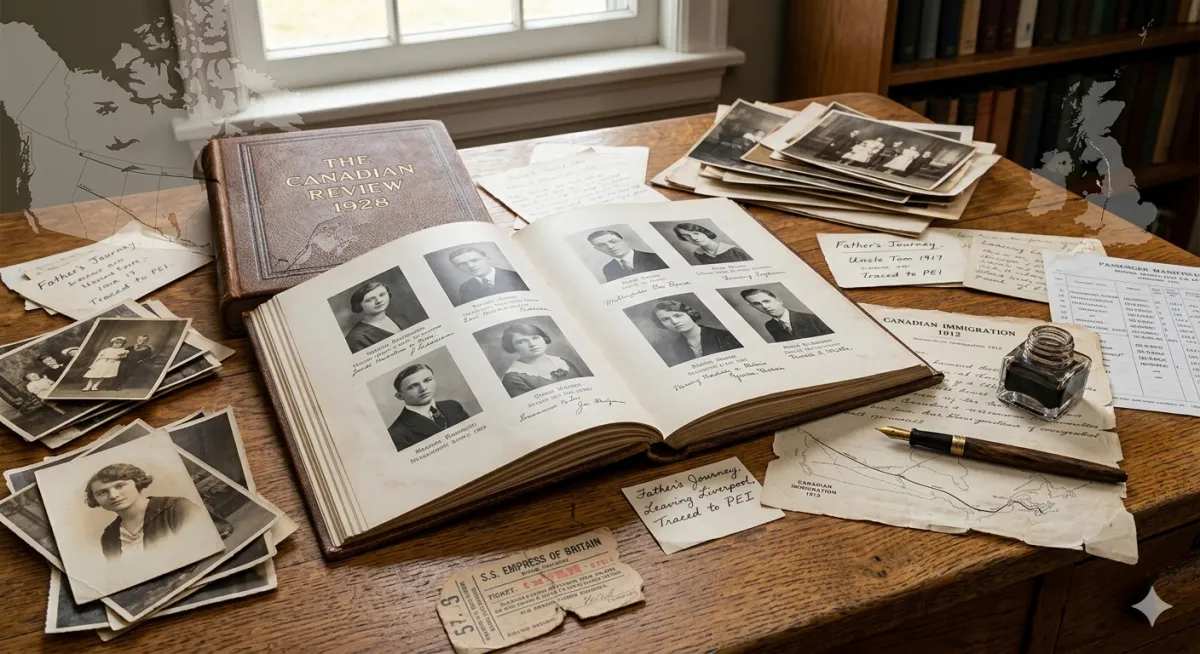
Within its pages, I found her name—along with a photograph that confirmed not only her presence at that school, but also the period in which she was there. That single entry helped me anchor her story in a way I had not been able to before.
Even more surprisingly, I also found my father in the same yearbook.
At that moment, two separate family histories converged in a single record. What began as an exploration of my mother’s immigration journey became a shared historical snapshot of both of my parents before their lives were formally connected.
The yearbook did more than confirm attendance. It placed them in the same time, the same community, and the same chapter of life before their paths fully intertwined.
It was a reminder that sometimes family history is not only about tracing backward—but about seeing how separate stories were quietly moving toward each other all along.
School Records as Windows into Identity
Beyond location and timing, school records often reveal early signs of identity and personality.
Yearbooks may show:
Club memberships
Sports participation
Academic interests
Friend groups
Aspirations or future goals
Report cards may reveal patterns in strengths, challenges, or educational progression.
These details help transform ancestors from names into individuals with interests, talents, and social lives.
The Hidden Value of Yearbooks
Yearbooks are often underestimated in genealogical research, yet they are among the richest narrative sources available.
They can provide:
Photographs of ancestors as young adults
Teacher and peer comments
Class lists and graduation records
Community context of a given year
Cultural and social snapshots of the time
For researchers, they are particularly valuable because they capture life before adulthood records begin—a stage often missing from official documentation.
A Poem Hidden in a Record of Education
Not all discoveries in school-related research are formal records.
While reviewing materials connected to my mother’s early life, I also came across something deeply personal: a poem she wrote following the tragedy of a ship launch.
Unlike official records, this was not about dates or attendance. It was a reflection of emotion, awareness, and response to events happening in the wider world at the time.
It added another dimension to her story—showing not only where she was, but how she experienced and interpreted the world around her.
For genealogists, these kinds of discoveries are especially meaningful. They remind us that our ancestors were not only participants in history, but observers and interpreters of it as well.
When School Records Change the Family Narrative
Discoveries like these often reshape family history in unexpected ways.
A single yearbook entry can:
Confirm migration timelines
Reveal unknown connections between families
Show overlapping life paths
Fill gaps in undocumented years
Connect separate branches of research
In some cases, they even correct assumptions that had been passed down through generations.
Genealogy is not static. It evolves with every new record uncovered.
Where to Find School Records
Depending on time period and location, school records may be found in:
School archives and administrative offices
Local school boards or districts
Public libraries and community archives
University or college archives
Online yearbook collections
Historical societies
Family-held collections
Older records may require more persistence to locate, but they are often worth the effort.
Preserving Educational History in Families
School records are often discarded or forgotten over time, yet they are among the most valuable personal historical documents a family can preserve.
Consider saving:
Report cards
Yearbooks
Graduation programs
Certificates and awards
Class photographs
School letters or correspondence
Digitizing these materials ensures they remain accessible for future generations.
More Than Education Records
At their core, school records are not just about education. They are about transition.
They capture a moment in time when individuals are moving from childhood into adulthood, forming identities, relationships, and life trajectories that will shape the future.
For family historians, they offer a rare glimpse into that formative stage.
A Closing Reflection
Sometimes the most meaningful discoveries in genealogy come from unexpected places.
A school yearbook is not just a record of students. It is a record of lives intersecting at a particular moment in time—some briefly, some permanently.
For me, finding both of my parents in the same yearbook was more than a research breakthrough. It was a reminder that family history is not only about tracing where we come from, but also about understanding how individual paths converge to create something entirely new.
Genealogy Challenge for June
Locate one school-related record from your family history—this could be a yearbook photo, report card, graduation program, or class list. Identify one detail that adds context to your ancestor’s life beyond basic dates, and record it in your family history notes.