Heirlooms with a Story — Discovering Family History Through Treasured Objects
Heirlooms with a Story — Discovering Family History Through Treasured Objects
Most families have at least one object that quietly carries more meaning than it first appears to hold. It may sit in a drawer, rest in a keepsake box, or be displayed on a shelf without much explanation. A photograph, a piece of jewelry, a handwritten recipe, a quilt, or even a simple tool can become a bridge between generations.
For family historians, these items are more than sentimental possessions. They are evidence—tangible links to lives lived, decisions made, and traditions carried forward.
While documents such as census records and birth certificates tell us where our ancestors were, heirlooms often tell us who they were.
What Makes a Heirloom?
An heirloom is not defined by monetary value, but by meaning and continuity. It is an object that has been passed from one generation to another, carrying with it memory, identity, and connection.
Some of the most meaningful heirlooms are not valuable in any financial sense at all. A worn apron, a handwritten letter, a child’s toy, or a simple recipe card can hold far more emotional weight than expensive antiques.
What makes an object an heirloom is not what it is, but who it connects us to—and why it was kept.
Objects That Carry Family Stories
Heirlooms come in many forms, and each has the potential to reveal something about family history:
Family Bibles and prayer books
Photographs and albums
Quilts and handmade textiles
Jewelry and keepsakes
Military medals and uniforms
Letters, diaries, and postcards
Recipe books and handwritten cards
Tools from trades or farming life
Certificates, awards, and documents
Immigration papers or travel keepsakes
Each object offers a different lens into family life. A medal may reveal military service. A quilt may reflect resourcefulness and creativity. A recipe book may preserve cultural heritage and family traditions.
The Family Bible: A Classic Genealogy Source
For many families, the family Bible is one of the most valuable heirlooms in existence. Traditionally, families recorded births, marriages, and deaths on its pages long before civil registration systems were widely available.
These entries often provide vital genealogical information that may not exist anywhere else. But beyond the dates and names, family Bibles frequently contain pressed flowers, funeral cards, handwritten notes, and photographs tucked between pages.
They become both record and memory—document and story intertwined.
Photographs: Clues Hidden in Plain Sight
Photographs are often the most common family heirlooms, yet they are frequently the least documented.
A box of unidentified photographs can feel like a mystery waiting to be solved. However, careful observation often reveals clues:
Clothing styles and fashion trends
Studio markings or photographer stamps
Background buildings or landscapes
Seasonal indicators such as foliage or snow
Handwritten notes on the reverse
Identifying photographs while older relatives are still available is one of the most valuable steps in preserving family history. A single conversation can prevent entire branches of a family tree from becoming nameless faces.
Quilts, Textiles, and Handmade Heritage
Handmade items often carry deep emotional and historical significance. Quilts, in particular, may contain fabric from multiple generations—repurposed clothing, baby garments, or fabrics tied to important life events.
These objects reflect not only skill and creativity, but also resilience and practicality. They often tell stories of hardship, celebration, migration, or family unity.
Documenting who created these items and why they were made helps preserve the context that future generations would otherwise lose.
Everyday Objects with Extraordinary Meaning
Not all heirlooms are elaborate or decorative. Some of the most meaningful items are the simplest:
A farmer’s worn pocketknife.
A teacher’s chalkboard eraser.
A carpenter’s hammer.
A grandmother’s recipe cards.
These everyday objects reveal how ancestors lived their daily lives. They connect us not only to milestones, but to ordinary routines—work, meals, celebrations, and care.
A Handwritten Pattern and a Family Tradition
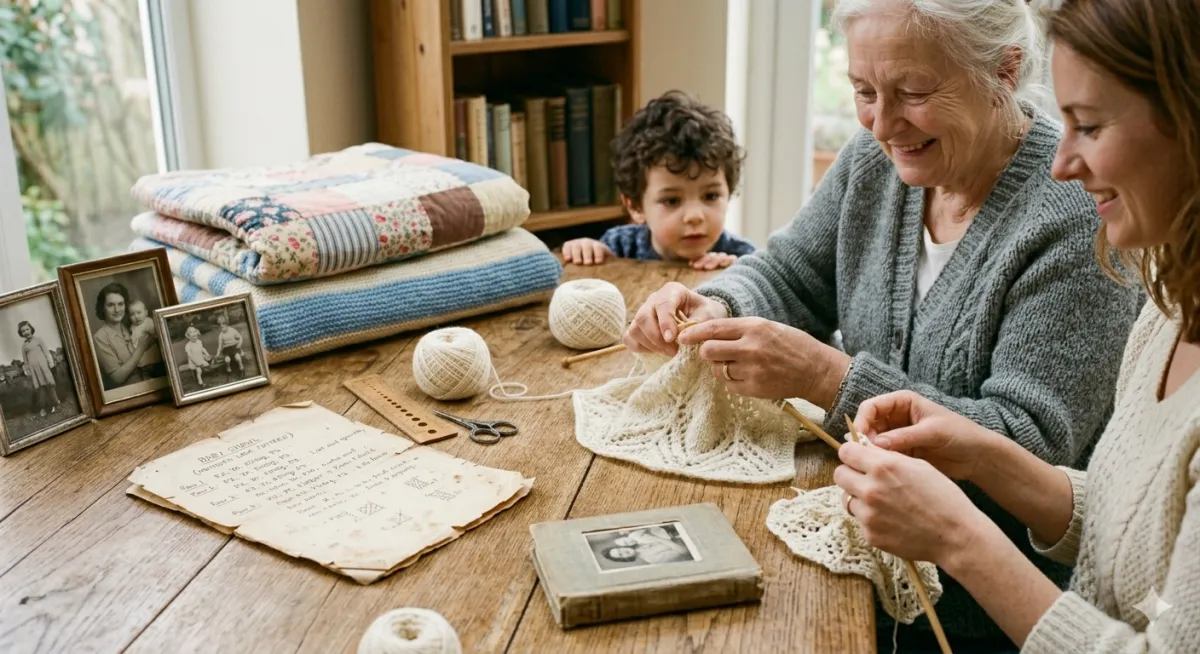
One of my most treasured family heirlooms is not a piece of jewelry or an antique photograph. It is a handwritten knitting pattern.
My grandmother knitted baby shawls for her children, grandchildren, and eventually her great-grandchildren. Over the years, she made so many that she rarely needed to refer to the pattern. The instructions became something she carried in memory rather than on paper.
After she passed away, I came across her handwritten pattern among family papers. Seeing her handwriting again brought back memories of her sitting quietly with her knitting needles, creating shawls that welcomed each new life into our family.
At first glance, the paper itself seemed simple. Yet it represented something far greater than instructions for knitting—it represented care, continuity, and love expressed through repetition and craft.
I made a conscious decision to continue that tradition. Using her handwritten pattern, I began knitting baby shawls for my own grandchildren.
Each time I pick up the needles, I am not only following instructions. I am participating in a ritual that began long before me. In every stitch, there is a connection—to her hands, her time, and her care.
The pattern has become more than an heirloom. It has become a living thread between generations.
Why We Keep What We Keep
One of the most revealing questions in genealogy is not what an object is, but why it was preserved.
People do not keep items by accident. They keep them because they matter.
A medal is kept because it represents service and sacrifice. A recipe book is preserved because it holds family gatherings in written form. A photograph is saved because it captures a moment that should not be forgotten.
Understanding why something was kept often tells us more about family values than the object itself.
When the Story Is Missing
Many families inherit heirlooms without knowing their origins. A photograph with no names. A piece of jewelry with no explanation. A letter without context.
When this happens, the story is not necessarily lost—it is simply waiting to be rediscovered.
Clues may be found in inscriptions, maker’s marks, family conversations, or historical records. Sometimes research reveals the story. Other times, the search itself becomes part of the family narrative.
Even uncertainty can be meaningful when it is documented and preserved.
Preserving Heirlooms and Their Stories
To ensure heirlooms remain meaningful for future generations, it is important to document both the object and its story.
Consider recording:
Who the item belonged to
How it was used
When it was created or acquired
Why it was kept
Any family memories associated with it
Photographs of the item itself
This information can be stored digitally, in family history software, or in a simple written record.
Without context, heirlooms become objects. With context, they become history.
More Than Objects
Ultimately, heirlooms are not about things. They are about people.
They connect us to those who came before, remind us of the lives they lived, and help us understand the values they passed down—sometimes intentionally, sometimes quietly through everyday actions.
And sometimes, as in the case of a simple handwritten knitting pattern, they do something even more powerful.
They continue the story.
Closing Reflection
One day, the objects we preserve today will become the heirlooms of tomorrow. The photographs we take, the recipes we save, and the traditions we continue will shape how future generations understand us.
By preserving both objects and their stories, we ensure that family history remains alive—not just recorded, but actively carried forward.
Because in the end, heirlooms are not just what we inherit.
They are what we choose to continue.