
Hidden Clues in Plain Sight: What One Family Photograph Revealed
Hidden Clues in Plain Sight: What One Family Photograph Revealed
One of the things I enjoy most about genealogy is discovering that the answers we seek are sometimes hiding right in front of us.
An old family photograph can be much more than a picture of people standing or sitting together. It can contain clues about family relationships, dates, occupations, military service, fashions, ages and even events that are not immediately obvious.
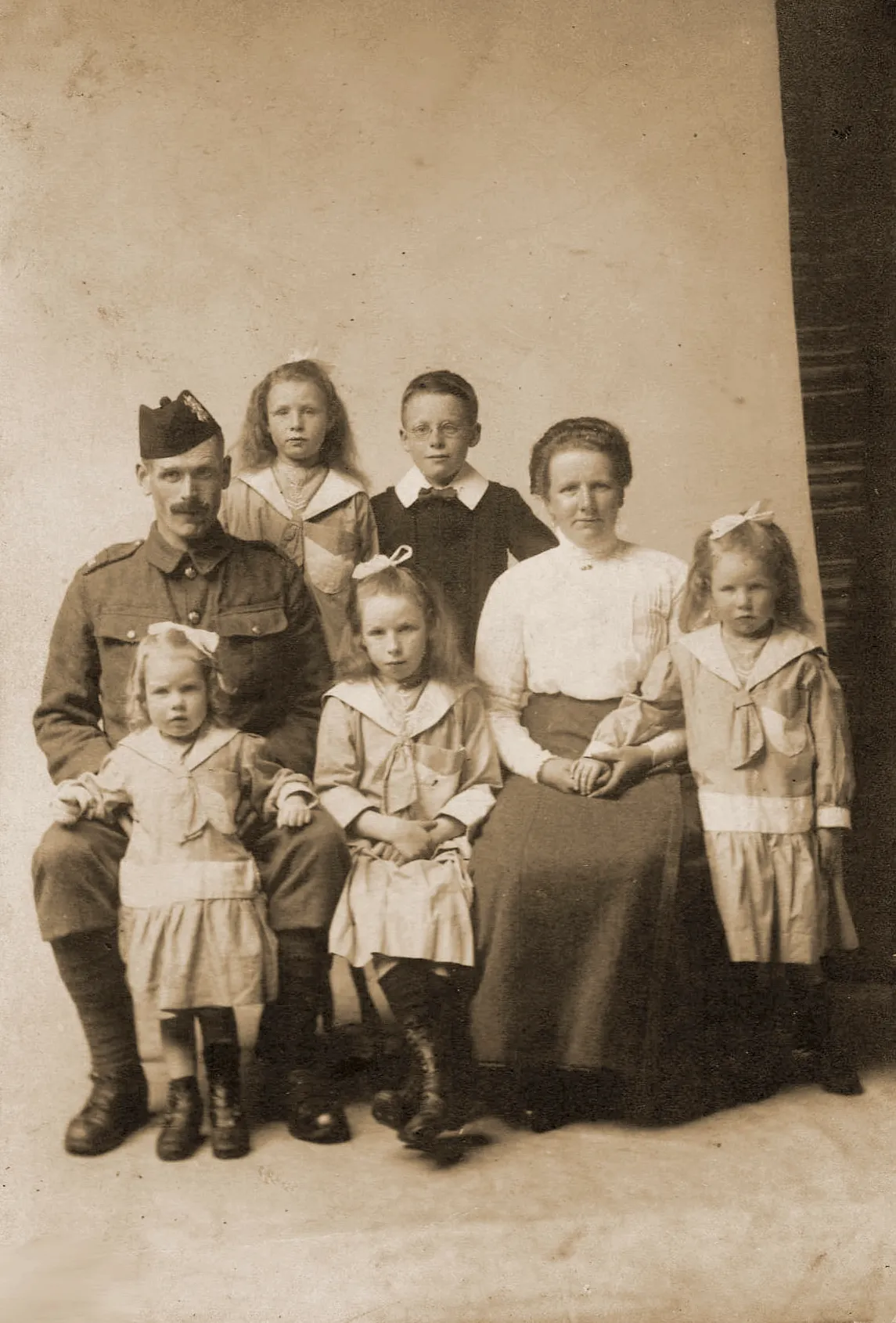
This photograph of my grandmother's family is a perfect example.
At first glance, it appears to be a simple family portrait of my great-grandparents and their children. But when I began to study the photograph more closely, I realized it was asking me questions.
And every answer seemed to lead to another.
My grandmother, Agnes, was one of the children in the photograph. She was born in 1908, the third child of David and Mary Young. Knowing the family's history gave me somewhere to begin, but the photograph itself still held several mysteries.
When was it taken?
How old were the children?
Why was my great-grandfather wearing a uniform?
And could all these small details help us tell the story behind the photograph?
Clue #1: The Man in Uniform
The first thing that caught my attention was my great-grandfather's uniform.
David Young was born in 1882. If the photograph was taken during the years surrounding the First World War, he would have been in his thirties. By the early 1920s, he was approaching 40.
That gave me an important starting point.
What branch of the military did he serve in? Was the photograph taken during the First World War? What could his cap, uniform and insignia tell us?
It is easy to look at an old photograph and make assumptions. A man in uniform must have fought on the front lines. But genealogy has taught me that assumptions are dangerous.
With the help of family members and further research, we determined that David was associated with a land regiment. The uniform was no longer simply an interesting detail in the photograph. It had opened another avenue of research into his military service.
But it also reminded me that every clue needs to be tested.
The uniform may help date the photograph, but only when considered alongside the other evidence.
Clue #2: Why Was the Photograph Taken?
The more I thought about David's uniform, another question occurred to me.
Why was this family photograph taken at all?
Professional portraits were important family possessions. Having a formal photograph taken required time and money, particularly for a working family with several young children. This was not the same as taking a quick photograph with a phone today.
During the First World War, however, photography took on an even deeper meaning.
Many servicemen visited photographic studios before leaving for war or while home on leave. They had their portraits taken in uniform, leaving copies with loved ones at home. Families also posed together so that soldiers could take photographs of their wives, children and other family members with them. These photographs became treasured keepsakes during long periods of separation.
The possibility that a soldier might not return made those images even more important.
For families who lost a husband, father, son or brother, a photograph could become a lasting memorial.
This made me look at my family's photograph differently.
Here was David in uniform, formally posed with Mary and their children.
Could this photograph have been taken because he was about to leave for military service?
Could it have been taken while he was home on leave?
Did he carry a copy with him?
Did Mary and the children keep one at home?
I do not yet know the answers.
And I cannot say that this was definitely the reason the photograph was taken.
But it is a possibility worth considering.
The photograph may not simply tell us something about David's military service. The war itself may help explain why this particular family gathered in front of the camera at that moment in their lives.
That possibility gives the photograph a different emotional significance.
When we look at it today, we see a family carefully arranged for a formal portrait.
But perhaps David saw something else.
Perhaps he saw the faces of the people he might soon have to leave behind.
Clue #3: The Children and the Missing Child
Sometimes one of the most important clues in a photograph is what is not there.
David and Mary's children were:
Alex, born in 1904
Mae, born in 1906
Agnes, my grandmother, born in 1908
Jean, born in 1910
Davida, born in 1913
Ann, born in 1922
Agnes was the middle child of the older group of children, with Mae two years older and Jean two years younger.
That relationship became important when studying the photograph.
At first, I wondered whether Agnes looked about 10 years old. If she did, the photograph could have been taken around 1918. The more I looked, the less certain I became.
That may sound like a small difference, but in genealogy, a difference of two or three years can be significant.
And then there was Ann. She was born in 1922 and does not appear in the photograph.
Her absence gives us an important boundary. The photograph was likely taken before her birth, or at least before she was included in this particular family portrait. Suddenly, we have a much narrower period to investigate.
This is an important lesson when studying family photographs. Don't just ask who is there.
Ask:
Who is in the photograph?
Who should be there but is missing?
When were the children born?
How old would each person have been at different points in time?
Do the apparent ages of the people support the same possible date?
Sometimes the missing person is just as important as the people we can see.
Clue #4: Looking at the Family, Not Just One Face
Trying to estimate the age of one child from a photograph can be difficult.
Children grow at different rates. Clothing and hairstyles can make them appear older or younger. The way they are posed can also be misleading.
Instead of asking only, "How old does Agnes look?", I began to look at the entire family.
Alex was four years older than Agnes.
Mae was two years older.
Jean was two years younger.
Davida was five years younger.
Those known age differences never changed.
That gave me something more reliable than simply guessing at Agnes's age.
If I identified Agnes correctly, the children should appear in a sequence that broadly reflects their ages. I could compare the older children with one another and then look at the younger girls.
The goal was not to say with certainty, "This child is exactly eight years old."
A better approach was to ask:
"Do the apparent ages of all the children make sense together in a particular period?"
When several people in a photograph point toward the same date range, the evidence becomes stronger.
Clue #5: The Girls' Dresses
The next clue was the clothing.
The young girls appear to be dressed in similar styles, with large collars and bows. It is possible that the dresses were chosen especially for the family portrait. They may have been made from similar patterns, purchased at the same time or simply reflected a popular style.
Could the dresses help date the photograph?
Possibly.
But clothing should not be used in isolation.
Fashion did not change overnight, and not every family wore the latest style. A dress could be worn for several years or passed down from one child to another.
Instead of asking, "What exact year were these dresses fashionable?", a better question is:
"Does the clothing support or challenge the date range suggested by the other evidence?"
If the children's ages suggest a photograph from around 1915 to 1918, does the clothing fit comfortably within that period?
The clothing becomes one piece of evidence among several.
Clue #6: The Family Behind the Photograph
The photograph also encouraged me to look more closely at the lives of the people in it.
David and Mary had met in 1901 while working at Wemyss Castle in Scotland. Mary was a servant and David was a gardener.
Their lives then took an unexpected turn. David left for Canada in 1903 with Mary following him. They married in 1904, before their first child, Alex, was born in St. John's, Newfoundland, Canada.
In 1905, the young family returned to Scotland. Their children were then born over the following years in Scotland, Swinton Bank Lodge in Peeblesshire.
David continued his career as a gardener and later became head gardener at Glenormiston Estate. I have found a photograph placing him there around 1932.
That later photograph is important evidence in its own right, but it also taught me something about the original family portrait.
I cannot simply assume that the earlier photograph was taken at Glenormiston because I know David was there in 1932.
A family historian must be careful not to make one piece of evidence prove something it cannot.
Instead, each discovery adds to the family's larger story.
David began as a gardener working on a Scottish estate. He and Mary crossed the Atlantic, began their family in Newfoundland and returned to Scotland. He continued his gardening career and eventually became a head gardener.
The family photograph captures them somewhere along that journey.
Our job is to work out where. And when.
Clue #7: Bringing the Evidence Together
This is where the photograph becomes much more than a photograph.
We have:
A father born in 1882
A military uniform that provides clues about his service
A possible wartime reason for the family to have a formal portrait taken
Children's clothing that may support a particular time period
Six known children with birth dates ranging from 1904 to 1922
Agnes, born in 1908, positioned between her older and younger siblings
A child born in 1922 who does not appear in the photograph
A family history that places the family in Scotland during the years when the older children were growing up
Later evidence of David's career as a head gardener at Glenormiston Estate around 1932
Individually, these clues provide possibilities. Together, they begin to tell a story.
At this point, I am not ready to claim an exact date for the photograph. I still believe it may have been taken before 1918, based largely on the apparent ages of the children, particularly Agnes and her siblings. The absence of Ann supports a date before 1922.
The fact that David is wearing a military uniform raises another intriguing possibility. If the photograph was taken during the First World War, perhaps the family's decision to have a formal portrait taken was connected to his service and an impending separation. But that remains a theory until more evidence is found.
And this is how genealogy works.
We begin with what we know. → We study the evidence. → We test our theories.
And we remain willing to change our minds when new information appears.
What Is This Photograph Trying to Tell Me?
When I first looked at this photograph, I simply saw my grandmother's family. Now I see much more.
I see a gardener and a servant who met while working at a Scottish castle.
I see a young couple who crossed the Atlantic and began their family in Newfoundland.
I see their return to Scotland and the birth of five more children.
I see my grandmother Agnes, born in 1908, standing somewhere among her brothers and sisters.
I see a father in uniform.
And I wonder whether that uniform was the reason the family gathered for this photograph.
Perhaps David was preparing to leave.
Perhaps he was home on leave.
Perhaps this photograph travelled with him.
Perhaps a copy remained with Mary and the children.
We may never know.
But those questions are now part of the photograph's story.
I also see clues.
A uniform.
Dresses.
Ages.
Family relationships.
And one missing child.
Each detail asks another question.
Each question leads to another piece of research.
That is one of the things I love most about family history. Our ancestors often leave pieces of their stories in unexpected places. A census record, newspaper article or military file may provide answers.
But so can an old photograph that has been sitting quietly in a family album for generations.
The next time you look at an old family photograph, don't just ask:
"Who are these people?"
Ask:
"What is this photograph trying to tell me?"
Look closely.
Study the clothing.
Examine the background.
Pay attention to uniforms, jewellery and small details.
Compare the people in the photograph with what you know from family records.
And perhaps most importantly, pay attention to who—or what—is missing.
The clues may have been hiding in plain sight all along.