Finding the Soldier
Finding the Soldier: A Beginner's Guide to Canadian Military Records
Remembering our ancestors who served means more than preserving their names. By exploring military records, we can begin to understand their experiences, their families and the lives they led.
The Ancestor Behind the Uniform
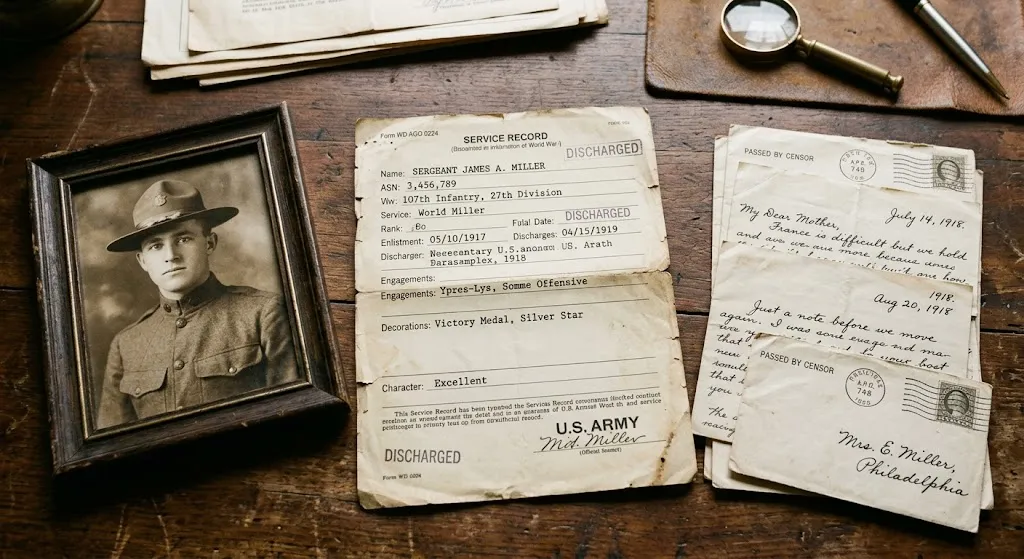
Perhaps you have a photograph of a great-grandfather wearing a military uniform. Maybe a family story mentions a grandmother who served as a nursing sister, an uncle who spent time overseas, or a relative who sailed aboard a merchant vessel. You may have discovered a medal tucked away in a drawer or a name on a memorial that you believe belongs to your family.
You know someone served, but the details are missing.
When did they serve? What was their role? Where did their service take them? What happened when they returned home?
These questions are at the heart of military genealogy. The answers may be found in a personnel file, a medal register, a ship's crew list, a newspaper article, a photograph or a collection of family letters.
Remembrance Day invites us to reflect on those who served and the sacrifices associated with military service. For family historians, it also offers an opportunity to look more closely at the people in our own family trees whose lives were shaped by that service.
We do not need to begin with a famous battle or a major war. We begin with a person.
The good news is that you do not need to be an experienced military historian to get started. With a few identifying details, a willingness to follow the evidence and some patience, you can begin uncovering your ancestor's story.
Step One: Gather What Your Family Already Knows
Before searching an archival database, take time to review the information already available in your family history research.
Start with the basics:
Full name, including middle names and possible variations in spelling.
Approximate date and place of birth.
Names of parents, spouse, siblings or other close relatives.
Approximate dates of military service.
Any known service number, rank, regiment, unit, ship or squadron.
Photographs, medals, letters, discharge papers or other family documents.
Do not worry if you have only a few of these details. They are starting points, not prerequisites.
Look carefully at family photographs. Is a cap badge visible? Does the uniform suggest a particular service branch? Is there writing on the back identifying a location, date or unit?
Medals may provide clues about the period of service, while letters and postcards may mention training camps, military postings, ships or overseas destinations. Even a newspaper clipping announcing an enlistment or homecoming can help establish a timeline.
Speak with older relatives, if possible. Ask what they remember and whether they know of documents or photographs held by other family members. Record these recollections, but remember that stories passed down through generations can contain errors or incomplete details.
Treat each piece of information as a clue to investigate rather than a fact to accept without question.
Step Two: Identify the Type of Service
The word soldier is often used as a general term, but our ancestors may have served in many different capacities.
Your relative might have been a member of the Canadian Army, Royal Canadian Navy or Royal Canadian Air Force. They might have been a nursing sister, a member of a women's service organization, a merchant seafarer or someone who served with the armed forces of another country.
Military service also extends beyond combat. Ancestors may have worked in medical services, communications, transportation, engineering, administration or logistical support. Others served in peacekeeping and international operations.
Establishing the type of service is important because different organizations created different records.
Ask yourself:
Was the person a member of Canada's armed forces?
Did they serve with the British or another country's military?
Were they a merchant mariner rather than a member of the navy?
Did they serve in a nursing, medical or other support role?
Was their service connected with a particular conflict, or did they serve during peacetime?
The answers will help determine which archival collections are most likely to contain relevant information.
Do not assume that every ancestor who served overseas was a member of the Canadian armed forces. Many Canadians served with British forces, and some families have ancestors whose military careers began before they immigrated to Canada.
Step Three: Begin with Library and Archives Canada
Library and Archives Canada (LAC) is one of the most important starting points for researching Canadian military ancestors.
Its collections include personnel files, muster rolls, medal registers, unit war diaries, photographs and other documents relating to military service across different periods.
Begin with the official research guide:
Library and Archives Canada: Military History
This guide provides links to collections and databases covering different conflicts, service branches and types of records.
Rather than assuming that all military records are organized in the same way, select the collection that best matches the information you have gathered.
An example: Researching a South African War veteran
Consider an ancestor who served in the South African War, commonly known as the Boer War, between 1899 and 1902.
Library and Archives Canada holds records relating to Canadian volunteers who served in South Africa. Its dedicated collection brings together service files, medal registers and land grant applications.
Some service files include enlistment information, physical descriptions, service histories, medical reports and discharge certificates. Land grant applications may provide a veteran's residence and a summary of military service.
Begin here:
South African War, 1899–1902: Service Files, Medals and Land Applications
This example illustrates why we should not restrict military genealogy to the two world wars. Records from earlier periods may survive and contain valuable information about an ancestor's life.
The same principle applies to other conflicts and military operations: identify the service, locate the relevant collection, and investigate the records that remain.
What if your ancestor served in a more recent period?
The availability of records varies according to when and where the person served, their service branch and whether they survived their service period.
For example, First World War Canadian personnel files are available online, while Second World War files for those who died in service between 1939 and 1947 can be searched online. Other Second World War files may be subject to privacy restrictions.
Records from more recent service periods may be held by Library and Archives Canada or the Department of National Defence, and access may require a formal request.
The official guide explains the available options:
Request Military Records and Service Files
Before requesting a file, gather as much identifying information as you can. Names, birth dates, service numbers, service branches and dates of death can all help narrow the search.
If a record is not available online, do not assume it has been lost. It may be held elsewhere or subject to access restrictions.
Step Four: Search Carefully and Consider Variations
One of the most common challenges in genealogy is finding a record when the name you enter does not match the name in the database.
Military records are no exception.
Names may have been misspelled, indexed incorrectly or recorded differently over time. An ancestor might appear under a middle name, initials, an anglicized surname or a spelling that differs from the one used by later generations.
If your first search produces no results, try a different approach.
Search by surname alone.
Try alternate spellings and known name variations.
Use initials or a middle name where appropriate.
Broaden the date range if the exact year is uncertain.
Remove optional search fields that may be restricting the results.
Check whether the ancestor served under another country's military.
Where a database permits searching by service number, regiment or unit, use these details to refine the results once you have a possible match.
Be cautious about concluding that a person is your ancestor simply because the name is identical. Compare the record with information you already know, including age, birthplace, next of kin and occupation.
Equally, a failed search does not prove that your ancestor never served. Some records have not survived, some have not been digitized, and others may be held in a different collection.
Sometimes the next useful clue comes from an entirely different source.
Step Five: Follow the Clues Beyond the Personnel File
A personnel file is an excellent starting point, but it rarely tells the whole story.
Once you identify a possible record, examine it carefully and note the details that could lead to further research.
A file might provide a service number, regiment, rank, ship, squadron or place of enlistment. Each of these details may open another avenue of investigation.
Medals and insignia: A medal or uniform badge may help identify a service period, unit or award. Compare the object with reliable reference material before drawing conclusions.
Newspapers: Local newspapers may report enlistments, promotions, casualties, homecomings and community commemorations. These reports can add personal and local context to official records.
War diaries and unit histories: If you identify the unit in which your ancestor served, records of that unit may help establish its movements and activities during the relevant period.
Ship and maritime records: For a merchant mariner or naval ancestor, the name of a vessel can become a valuable research lead. Maritime records may document employment, voyages and crew members.
Women's service records: Nursing records and records of women's military organizations can reveal service details that may not appear in the collections commonly used to research male soldiers.
Library and Archives Canada holds a broad range of these materials. Its military history research guide is a useful place to explore related collections.
The goal is to follow each clue to the next source, gradually building a more complete account of your ancestor's service.
Step Six: Reconnect Military Service with Family History
Military genealogy should not end when the service record has been found.
Your ancestor had a life before joining a military organization and, in many cases, a life after leaving it. Connecting those chapters can reveal how service affected the individual and the wider family.
Return to the familiar sources of genealogical research:
Census records.
Birth, marriage and death registrations.
Passenger lists and immigration records.
Electoral lists and city directories.
Newspapers, obituaries and local histories.
Cemetery and burial records.
Family correspondence, photographs and oral histories.
These records may help you establish where an ancestor lived before service, who depended on them, whether they returned to an earlier occupation, or whether they moved to another community afterward.
They can also help explain changes in a family. Military service may have influenced migration, employment, marriage, family relationships and where subsequent generations settled.
For an ancestor who died during service, memorial and burial records may provide additional information. For a veteran who returned home, civilian records may help trace the years that followed.
Always consider the evidence together. A military record may establish a posting, while a census record identifies a household years later. Neither necessarily explains the connection on its own, but together they may help reconstruct a life.
Step Seven: Document What You Discover
As your research develops, record where each piece of information came from.
For each source, note the repository or website, collection name, record title, identifying reference numbers and relevant page or image details. For online sources, record the access date where appropriate.
Save copies of documents using meaningful filenames. A file named Smith_John_Service_Record is much easier to locate later than one called scan001.
Maintain a research log that records the questions you asked, the searches you tried, the sources you examined and the conclusions you reached.
It is equally important to distinguish between documented facts and interpretation.
A service record might establish that an ancestor belonged to a particular unit. A unit history might show that the formation participated in a specific operation. That does not automatically establish the individual's presence at every event involving the unit.
Where the evidence is incomplete, acknowledge the uncertainty. A carefully documented family history is more valuable than a dramatic story built on assumptions.
Your Research Challenge: Begin with One Ancestor
You do not need to reconstruct an entire military career in one sitting. Start with one person and one question.
Choose an ancestor who you believe served in a military or related service organization. Gather the information you already have, identify the likely type and period of service, and consult the relevant archival guide.
If you find a record, write down three new facts it reveals about the individual. Then consider what other records might confirm or expand those details.
If you do not find a record, review your assumptions. Try alternative spellings, search for a unit or ship, examine family documents, or explore civilian sources that might help establish the person's identity.
Either way, you will have taken a step toward recovering a part of your family history.
Remembrance Through Research
Military records are more than administrative documents. They preserve fragments of individual lives: an occupation recorded before enlistment, a family member named as next of kin, a medal awarded, a voyage undertaken or a posting recorded in a service file.
Sometimes the evidence is extensive. Sometimes only a few details remain.
By bringing those details together with photographs, family memories, civilian records and historical sources, we can begin to see more than a name on a page. We can begin to understand the person, the family and the circumstances in which they lived.
Remembrance Day gives us an opportunity to reflect on those who served, including ancestors whose experiences may never have been fully discussed or understood within their families.
This November, consider choosing one of those ancestors and beginning the search.
Find the record. Follow the clues. Preserve the story.
Because remembering our ancestors is not only about honouring the past. It is also about ensuring that their stories remain part of our family history.